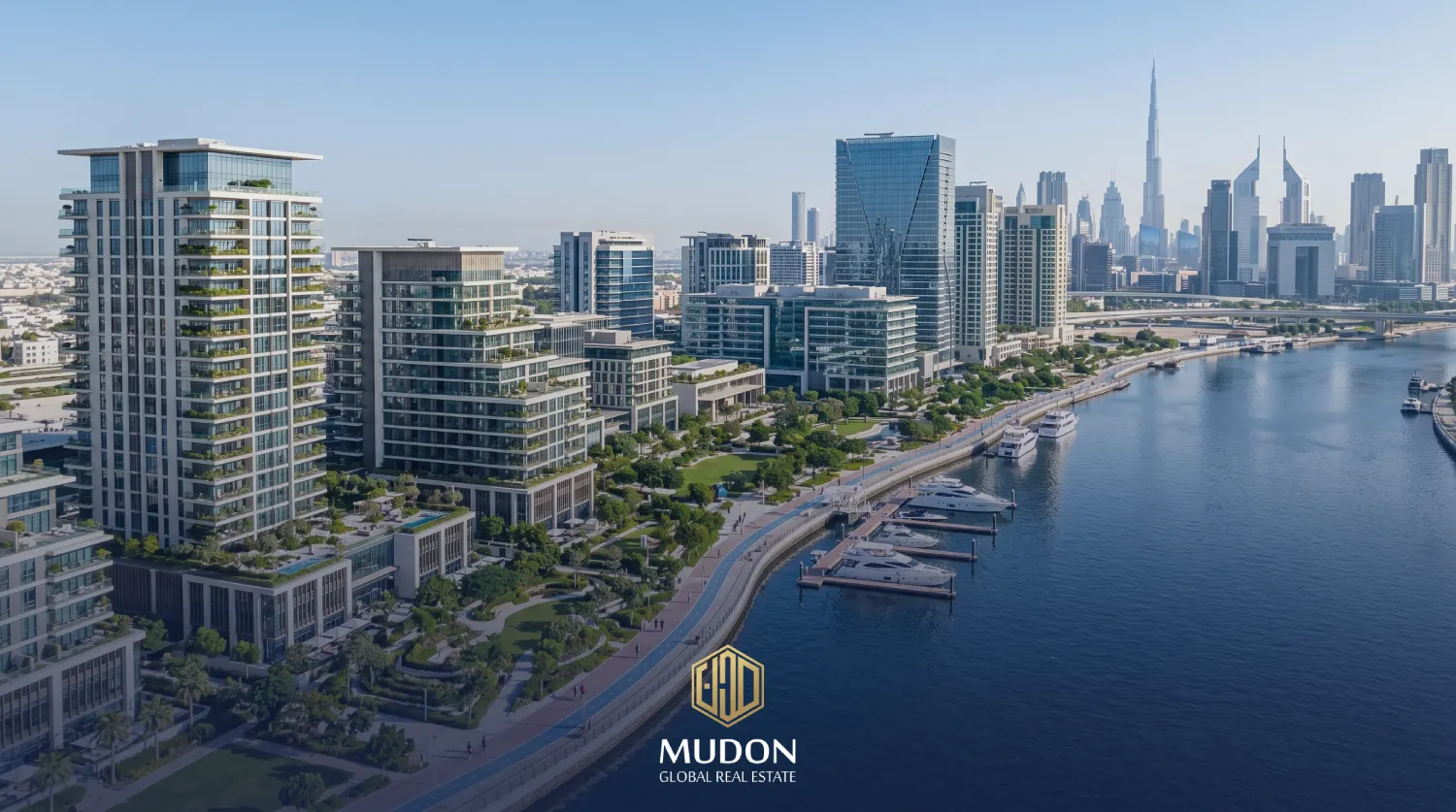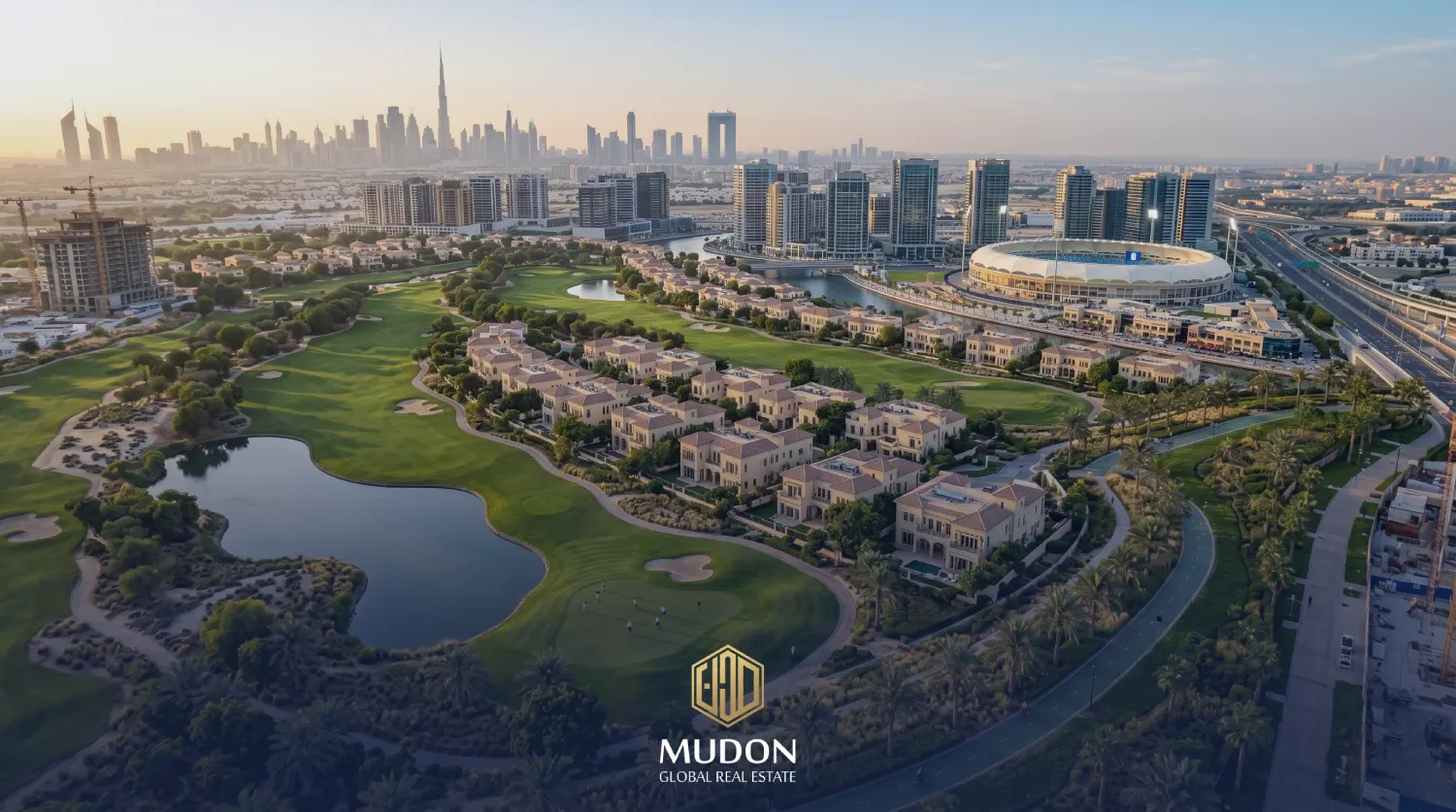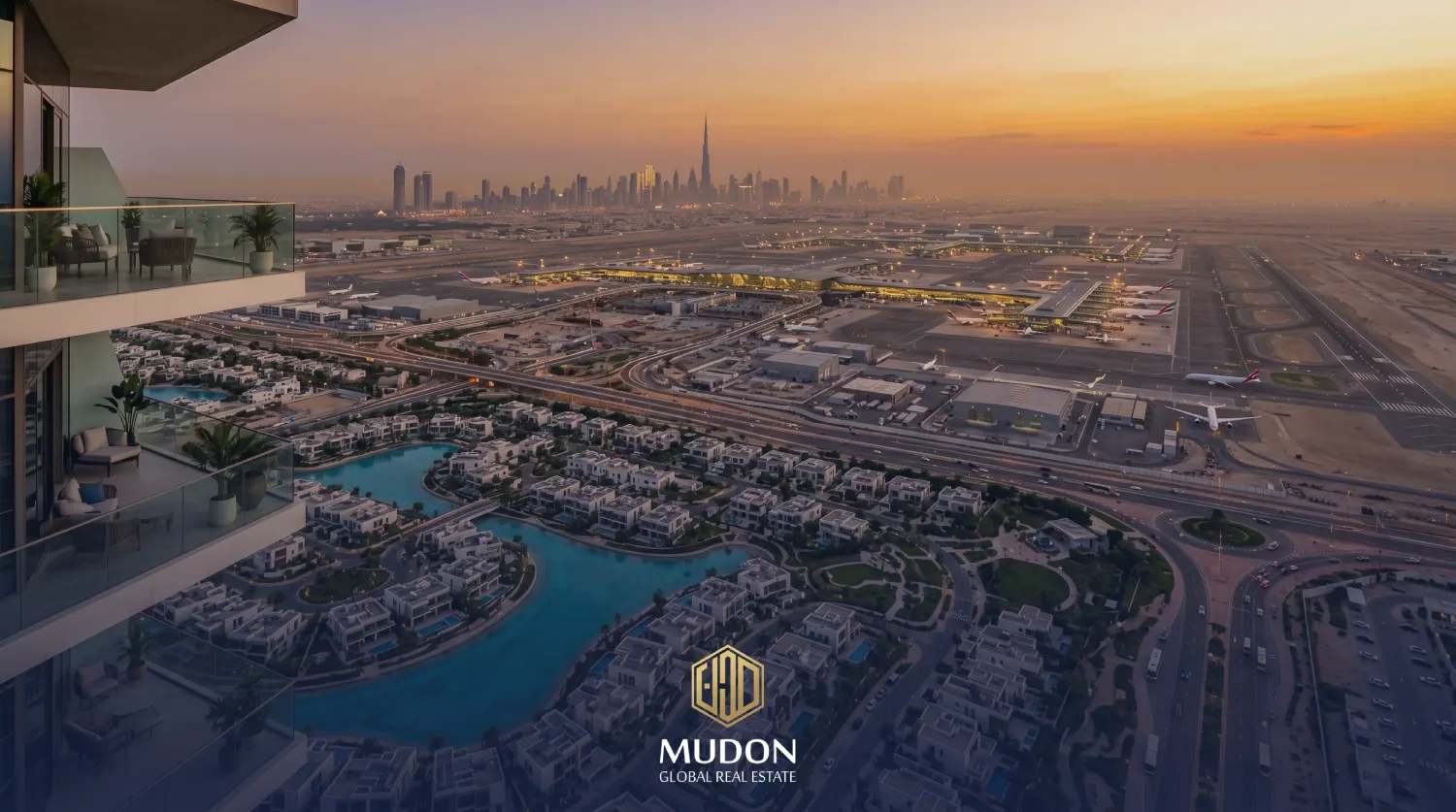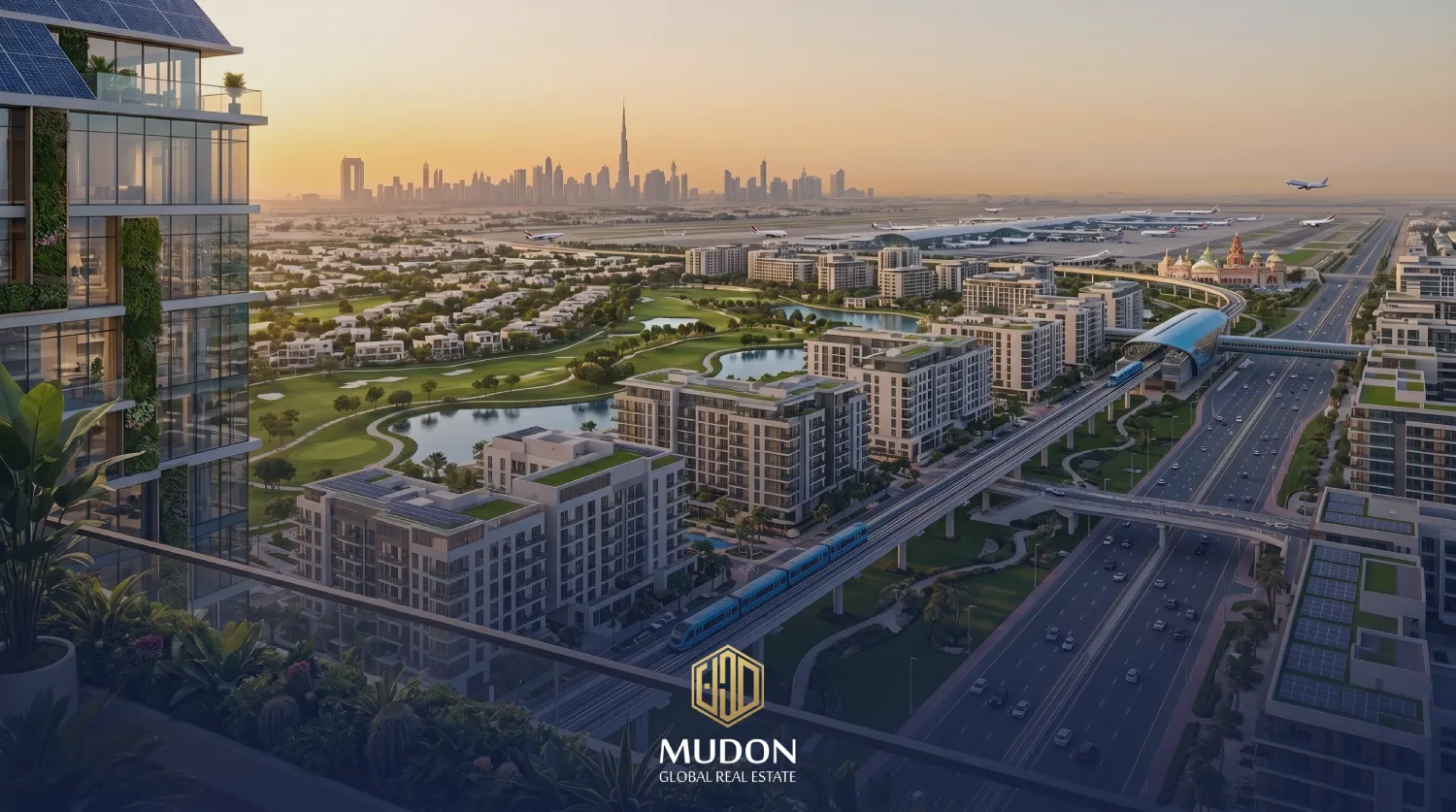
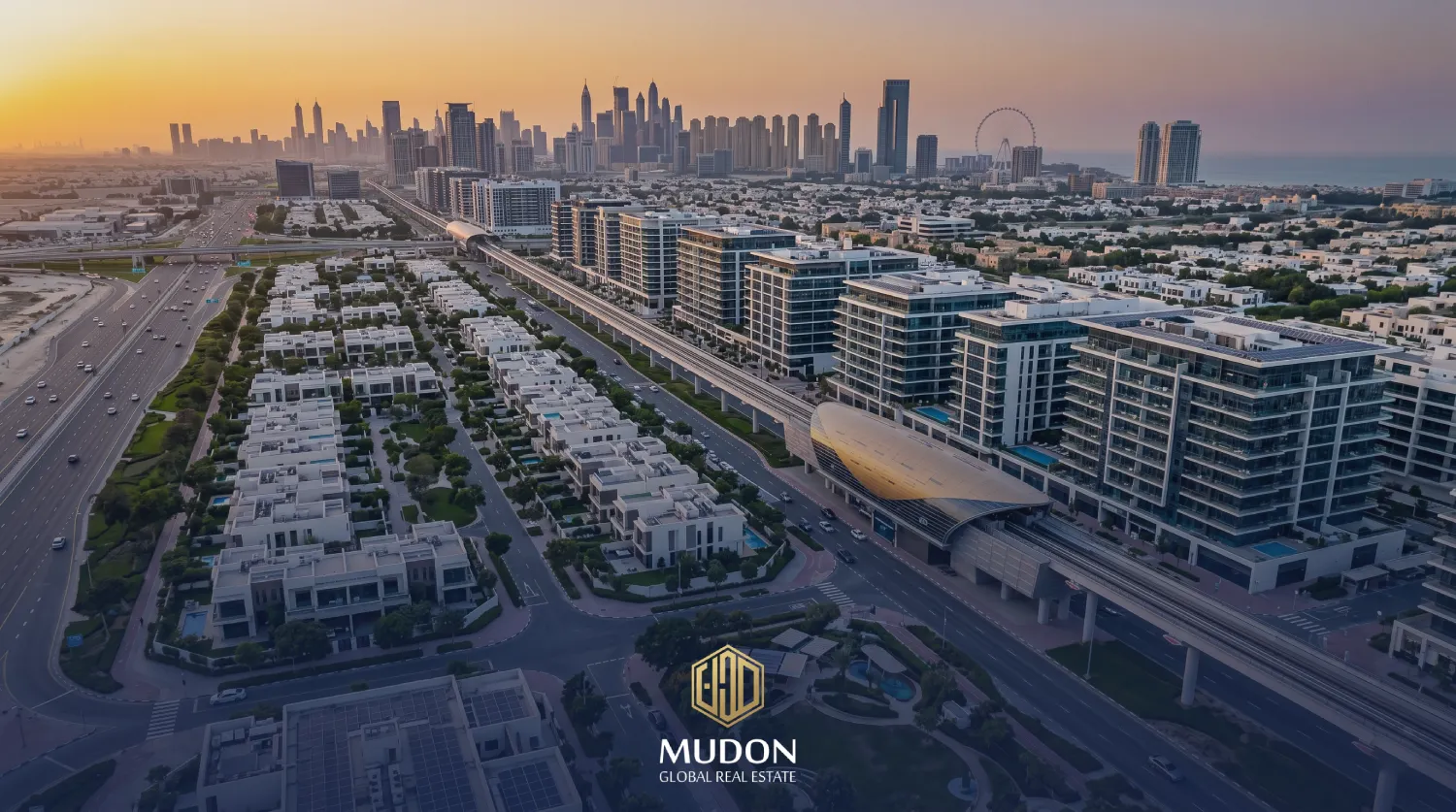
In the 2026 property cycle, the compass of “smart liquidity” is shifting toward areas that have successfully transitioned from projects under development into mature, self-sufficient communities. “Al Furjan” (Al Furjan) stands out as one of the strongest real estate nodes in Dubai’s “mid-market premium” segment.
Al Furjan is no longer merely a promising district; it has become a robust engine for yield generation, supported by integrated infrastructure and substantial demographic inflows.
At Mudon Global, we understand that the strategic investor today relies on independent research and deep data analysis before making financial decisions. Accordingly, we designed this report as an intensive analytical tool to support your informed conclusions and provide a precise breakdown of Al Furjan’s market mechanics, beyond repetitive templated recommendations.
Table of Contents
Geographic and Economic Identity: What is “Al Furjan” from a capital perspective?
For the international investor reading Dubai’s map from abroad, the name “Al Furjan” may appear to be a simple local term with a traditional residential character.
However, when this geographic area is assessed through the lens of “2026 financial valuation and demographic analysis”, a completely different investment reality emerges; the district is classified as a “strategic urban incubator for the mid-market premium segment” (Mid-Market Premium) and is considered one of the fastest maturing and most self-sufficient residential communities in New Dubai.
To understand how liquidity moves and valuations compound within this extended district, its core identity must be deconstructed through the following institutional lenses:
1. The Trusted Development Umbrella (The Master-Developer Moat)
Al Furjan did not emerge by chance; it is a sovereign project planned and launched by the largest semi-governmental real estate developer: “Nakheel”—the same engineering mind behind Dubai’s global icons such as Palm Jumeirah and Palm Jebel Ali.
Investment Impact: Nakheel’s role as the master developer of the master plan gives the international investor an “institutional backing” guarantee that quality of life, green spaces, internal road networks, and community centers are managed to the highest global standards, protecting properties from valuation downside risk and enhancing their secondary market value.
2. The Concept of “Smart Urban Sprawl”
In its current cycle, Dubai has moved away from detached building patterns and is advancing decisively toward “integrated connected communities.” Al Furjan is the practical embodiment of this direction; it extends as a residential environment that combines low-density luxury villas and compact mid-rise towers, creating a rare demographic mix that balances settled families and young professionals.
3. Financial Positioning: Leadership in the “capital efficiency” class
In the 2026 financial lexicon, Al Furjan is known as a “sanctuary of sustainable yields”. It is the district that has solved the investor’s difficult equation: “low and competitive entry price + highly mature infrastructure linked to the metro”.
This positioning gives the district’s assets a dual shield; they absorb excess liquidity from ultra-expensive waterfront areas and operate as a natural outlet for upper-middle-class residents and executive professionals, ensuring net rental yields of 6.8% to 8.2%, figures that are difficult to achieve in saturated prime areas.
Geospatial Analysis and Logistical Connectivity: Access Engineering and the Arterial Nexus Node
In the financial and modern real estate portfolio management discipline of 2026, assessing an asset’s value no longer depends solely on its visual appeal or internal area, but on its ability to suppress the “geographic monopoly of frictionless mobility” (Frictionless Mobility).
When Dubai’s urban map is subjected to precise “geospatial analysis” (Geospatial Analysis), the “Al Furjan” area emerges as a highly vital “arterial nexus node” (Nexus Node), representing the link between the two largest macroeconomic growth engines in South Dubai and its northern coast.
This strategic location is not merely a set of coordinates on a map; it is a solid competitive advantage that translates directly into distinguished real estate performance metrics through the following operational dimensions:
First: The Dual Logistical Monopoly and the “Golden Triangle” of Capital Flow
Al Furjan enjoys a unique geographic positioning that gives it what is known in real estate as “dual arterial immunity”; it lies within a vital strip geometrically positioned between the UAE’s two most important logistical corridors:
The Sheikh Zayed Road (E11) and Sheikh Mohammed Bin Zayed Road (E311) Corridor
This road symmetry gives Al Furjan residents absolute flexibility in traffic maneuvering. Through direct internal links—chief among them Al Yalayis Road (D57) and Qarn Al Sabkha Road—residents can enter and exit the community within two minutes, completely avoiding the internal bottlenecks that affect deeper communities.
Balancing Wealth and Prestige (The Golden Middle)
Al Furjan sits exactly at the golden midpoint between the Jebel Ali Free Zone (JAFZA)—the industrial and commercial backbone for the businesses and regional headquarters of thousands of multinational companies—and Dubai’s coastal and leisure heart (Dubai Marina, JBR, and Bluewaters).
This central location allows the property to capture “excess liquidity” from both sides; it attracts senior professionals seeking quiet family living close to their Jebel Ali workplaces, without sacrificing a luxury coastal lifestyle less than 10 minutes away.
Second: The “Route 2020” Artery Effect (The Route 2020 Metro Effect) and Transit-Oriented Development Engineering
By 2026, Al Furjan has moved beyond the stage of promises and future projects; the Dubai Metro’s Route 2020 corridor is now a highly mature mass transit system linking the district directly to the Dubai International Financial Centre (DIFC) and Dubai International Airport, extending to Expo City.
Monetizing the “Metro Premium”: Al Furjan is classified as one of the successful examples of “Transit-Oriented Development – TOD”; it has two main stations operating at full capacity (Al Furjan Station and Discovery Gardens Station).
Engineering Superior Rental Liquidity: Current market data show that properties within walking distance (5 to 10 minutes) of these two stations enjoy strong, inelastic rental demand.
The Dubai tenant in 2026 now places vehicle-free transportation efficiency as a first-line priority for hedging commuting costs; this completely eliminates “rental vacancy hazard” and gives landlords the negotiating power to impose sustainable price increases upon renewal.
Third: The Total Residential Sink and Capturing the “Captive Audience” of South Dubai
The third logistical dimension that ensures the immunity of Al Furjan’s assets against any market corrections is the area’s function as a “natural and inevitable residential sink” for the largest employment concentrations in the emirate:
The Human Magnet of Jebel Ali and the Airport (DWC)
With the major construction and operational surge seen at Al Maktoum International Airport (DWC) and “Dubai South” in 2026, massive human waves of administrative staff, pilots, engineers, and logistics experts have flowed into South Dubai.
These individuals seek mature residential communities with complete amenities and a high quality of life (retail centers, international schools, and leisure facilities) to anchor their family stability.
Creating “Inelastic Demand”
No real estate district in the South Dubai area offers this combination of “community maturity” and “pricing efficiency” like Al Furjan. This reality creates a “captive audience” of high-net-worth tenants, who act as a protective shield for the asset.
Owning an asset in Al Furjan today is equivalent to owning an “investment refinery” that absorbs the cash generated by the salaries of the emirate’s major sovereign and logistics sectors and converts it into stable net rental returns in your portfolio.
Micro-Geography: Deconstructing Asset Communities and Engineering Financial Allocation
Viewing Al Furjan as a homogeneous real estate block is a fundamental error in the financial engineering calculations of 2026 investment portfolios. The area’s growing demographic appeal requires its map to be decomposed at a micro-geographic level based on the “structural pattern of the asset”; the architectural and spatial design dictates the “profit code” and determines the quality of cash flow and risk levels within your portfolio.
To achieve maximum efficiency in capital allocation, the real estate supply in Al Furjan is divided into two operational sectors that function with distinct yet complementary financial mechanisms:
First: Horizontal Communities (Villas & Townhouses) – The Hedging Shield and Net Value Preservation
This sector represents Al Furjan’s low-density urban residential zone, led by mature strategic projects such as “Tilal Al Furjan” and “Murooj Al Furjan”, both developed by Nakheel.
Asset Engineering and Demand Dynamics
These gated communities rely on the development of expansive villas and townhouses (4- and 5-bedroom layouts), designed in a modern-classic style that targets large families and senior executives.
The key magnet here is the “space versus price” equation; this high-net-worth segment seeks privacy and open spaces at competitive entry prices, away from the benchmark pricing seen in areas such as Emirates Hills or Palm Jebel Ali.
Financial Behavior and the Defensive Moat (The Defensive Shield)
This sector is classified as a “defensive sovereign asset” designed for wealth preservation strategies and macro-hedging against inflation. These assets exhibit exceptional financial stability, resulting in near-zero tenant churn; resident families remain for many years because of nearby international schools and community centers, eliminating vacancy periods and recurring property maintenance costs.
Net ROI here ranges between 5% and 6%, but the real strength lies in sustained and accelerated capital gains driven by the absolute scarcity of horizontal land available for development in this logistical corridor.
Second: Smart Mid-Rises – Machines for Generating Intensive Cash Flow
This sector represents the area’s vertical urban belt, and 2026 saw exceptional architectural launches targeting millennials, young professionals, and international investors, led by pioneering projects such as “Casa Altia” by Yas Real Estate Development, and the Sparklz and Samana California 2 projects.
Technology and Operations in a SaaS Model
These towers have moved beyond the concept of traditional living and adopted “PropTech architectural engineering.” Smart Home Automation and the Internet of Things (IoT) are fully integrated into the building’s structural fabric. This integration provides the owner and resident with digital operational dashboards that mirror the interfaces of high-end Silicon Valley software.
This software precision allows the remote investor to monitor energy and water consumption to benchmark standards, fully control security systems, and manage predictive maintenance and unit leasing with a single click, crushing hidden administrative costs.
Financial Behavior and Capturing the “hotel amenity premium”
These towers are the portfolio’s “true cash flow engines” (Yield Farming). Thanks to flexible entry prices and the substantial demand from professionals working in Jebel Ali and Dubai South, these units generate the highest net rental yields in their class, ranging between 6.8% and 8.2% annually.
Creating “Inelastic Demand”
Including amenities that replicate a five-star resort—such as co-working spaces, smart fitness lounges, and private pools integrated into apartment balconies (as in Samana’s design philosophy)—creates a state of “inelastic demand”.
The tenant becomes willing to pay a “rental premium” exceeding market averages by 12% to 15% in exchange for this integrated lifestyle experience, pushing occupancy rates to their maximum and ensuring capital rotation with exceptional efficiency and speed.
Capital Allocation Comparison Table (Al Furjan 2026)
| Financial and Operational Metric | Horizontal Community Segment (Villas) | Smart Tower Segment (Apartments) |
| Portfolio Strategic Objective | Capital preservation and long-term capital growth | Maximizing cash flow and monthly liquidity |
| Operational Management Model | Stable and guaranteed traditional annual lease | Flexible / smart / PropTech-integrated leasing |
| Target Tenant Profile | Families, executives, long-term expatriates | Young professionals, digital nomads, logistics code |
| Annual Service Charges | Very low (calculated based on net land area) | Moderate to high (covers amenity and pool maintenance) |
| Tenant Churn Rate | Close to zero (stability extending from 3 to 5 years) | Average (requires negotiation flexibility and digital management) |
| Expected Net Rental Yield | 5.0% – 6.0% (inflation-resistant) | 6.8% – 8.2% (intensive, sustainable yield) |
Financial Analysis and the Language of Numbers in 2026: Arbitrage Engineering and the “Monthly Targets” Strategy
In mature property markets, capital intelligence is not measured by the amount of liquidity injected into the market, but by how efficiently it is directed to capture cases of “positive pricing distortion”.
In the 2026 financial cycle, Al Furjan represents the clearest example of this condition; its assets trade at a visible capital discount that does not reflect the true maturity of its logistical infrastructure and fully operational metro network.
For the institutional investor or real estate portfolio manager, this distortion opens a rare window to build highly profitable positions and apply advanced financial engineering that de-risks the portfolio and maximizes cash flows through three numerical analytical axes:
1. Attractive Entry Points and the Bulk Allocation Tactic
The pricing structure of Al Furjan in 2026 is characterized by high capital flexibility, allowing investment opportunities to be monetized without locking massive blocks of liquidity into a single asset:
Entry Price Matrix: Luxury studio prices in new and updated projects start from AED 550,000 to AED 650,000, while one-bedroom apartments (1BHK) range between AED 850,000 and AED 1,100,000.
Crushing concentration risk through bulk buying: Instead of directing AED 3 million into a single apartment in saturated prime areas (such as Downtown Dubai), this lower price band enables the investor to acquire a portfolio of 4 to 5 compact units within Al Furjan.
The operational translation of risk fragmentation: Distributing liquidity across several compact assets ensures portfolio diversification of the tenant base. If one unit experiences a temporary vacancy for repainting or maintenance, the other four units continue operating efficiently and generate cash flow that covers obligations and protects the overall return, thereby increasing the investor’s margin of safety.
2. PSF Arbitrage and the Price Convergence Theory
The strongest mathematical driver of future capital growth in Al Furjan lies in the pricing discount gap compared with areas adjacent to Dubai’s main arteries:
Price Per Square Foot (PSF) indicator: The average price per square foot for luxury and smart projects nearing handover in Al Furjan ranges between AED 1,000 and AED 1,300.
The Strategic Discount Gap (The 30% Discount Gap): Based on 2026 market metrics, this price is approximately 30% lower than technically and structurally comparable assets offered along Sheikh Zayed Road or in marina-adjacent communities, despite Al Furjan having direct metro and highway connectivity comparable to those areas.
Capturing Handover Wave Gains (2026 – 2027 Handover Waves): The professional investor understands that this pricing discount is a temporary distortion that will inevitably close. As the major handover waves continue through the second half of 2026 and throughout 2027, and as the luxury character of the smart towers matures, Al Furjan prices will move upward toward convergence with its geographic surroundings.
Entering at this stage allows the portfolio to capture “unearned equity” that converts into net capital appreciation upon exit.
3. Performance Monitoring Engineering: The Philosophy of “Monthly Targets” and Crushing Market Noise
In institutional real estate valuation, success in asset management is tied to the precision and realism of measurement and monitoring tools. Practical experience in 2026 has proven that planning and financial performance monitoring for Al Furjan properties must rely exclusively on “fixed monthly goals and metrics”:
Weaknesses of weekly granular tracking: Attempts to track real estate portfolio performance on a weekly or daily basis are a strategic error; they push the investor to absorb “market noise” and momentary speculation that do not reflect operational reality. Excessive weekly tracking creates analytical dispersion and is not suited to the nature of real estate cash flows.
The operational philosophy of monthly targets: Real estate assets naturally move and breathe on monthly cycles. Utility bills, district cooling charges, smart rent yield distributions, and tenant cheque collection cycles (whether from individuals or logistics companies from Jebel Ali) are all designed and programmed on a monthly basis.
Building Digital Dashboards (Operational Dashboards): Successful investment in Al Furjan requires structuring the financial reporting system around clear monthly performance indicators:
- Monthly net cash flow: After deducting predictive maintenance expenses and smart energy consumption.
- Target monthly occupancy rate: Specifically when monetizing units through flexible or medium-term rental strategies.
- Sinking fund accumulation matrix: Set aside monthly to protect the asset from architectural depreciation.
This rational and systematic methodology gives the investor a calm, linear, and automated reading of wealth growth, away from short-term volatility, while enabling the highly efficient reinvestment of monthly returns to seize new opportunities in the market.
Expected Financial Performance Matrix for Al Furjan Apartments (2026 Cycle)
| Standard Financial Metric | Smart Studio Units | One-Bedroom Apartments (1BHK) |
| Average Entry Price (AED) | 550,000 – 650,000 | 850,000 – 1,100,000 |
| Average Price Per Square Foot (PSF) | AED 1,100 – 1,300 | AED 1,000 – 1,200 |
| Current Valuation Discount Gap | ~30% compared with the prime corridor | ~30% compared with the prime corridor |
| Target Net Rental Yield | 7.5% – 8.2% (digital/flexible management) | 6.8% – 7.5% (stable / corporate leases) |
| Recommended Performance Review Cycle | Monthly (Monthly Base) | Monthly (Monthly Base) |
| Expected Capital Growth (2026-2027) | 8% – 11% annually | 7% – 10% annually |
Environmental, Social, and Governance (ESG) Standards: Converting Environmental and Social Sustainability into a Financial Lever for Assets
In the advanced property markets of 2026, ESG compliance assessment has moved beyond theoretical arguments to become a “fundamental financial pillar” that determines capital flows and an asset’s readiness for institutional exit.
The international investment fund or family office is no longer looking for bare concrete walls, but for “sustainable ecosystems” capable of protecting themselves from energy cost volatility and legally insulated against future carbon tax regulations.
In its current 2026 cycle, Al Furjan presents a mature model of how ESG standards are integrated into a district’s master plan, turning environmental engineering and urban design into operational tools that cut excess costs and push net returns to the top.
1. The Social and Environmental Dimension: The “15-Minute City” and Urban Self-Sufficiency
The urban dimension of Al Furjan focuses on re-engineering spaces to reduce carbon dependence, which translates in real estate terms into a “lifestyle premium” that improves tenant retention rates:
Infrastructure free of mechanical friction: Al Furjan was not designed merely as roadways for cars; rather, wide pedestrian spaces and naturally shaded, isolated cycling paths connect the residential neighborhoods. This geospatial design reduces carbon emissions from short internal trips, achieving the concept of a “15-minute city.”
Community centers as demographic stability nodes: Key centers such as Al Furjan Pavilion and Al Furjan Club play the role of “urban anchors.” Providing retail, gyms, clinics, and schools within walking distance gives the district a self-sufficiency advantage.
The financial impact on the real estate portfolio: From an asset management perspective, the integration of this ecosystem raises the “tenant satisfaction index”. A resident who finds all lifestyle and social needs without leaving the community tends to renew the lease for longer periods, eliminating tenant churn and protecting the portfolio from hidden vacancy periods.
2. The Environmental and Engineering Dimension: Green Architecture and OPEX Optimization
The most compelling and high-impact financial driver in the new projects launched in Al Furjan in 2026 (such as Casa Altia and Samana and Danube’s smart towers) lies in their revolutionizing of building operating costs through sustainable construction technology:
A. Building Envelope Engineering and Strict Thermal Insulation
The 2026 projects adopt strict building codes based on high-thermal-mass shells for walls and roofs. This insulation prevents heat exchange between the hot outdoor climate in summer and the building’s internal environment, reducing the core load on air-conditioning and cooling systems.
B. Smart Glass Facades and Daylight Harvesting
Advanced glass facades treated with nano technologies are used (such as double Low-E glass). This technology transmits natural light fully to illuminate apartments and corridors, but it blocks and filters the infrared and ultraviolet rays responsible for heat transfer.
3. The Numbers: How Does ESG Compliance Translate into Higher Net ROI?
The combination of “superior thermal insulation” and “smart facades” produces a linear financial equation that directly benefits the property owner:
Building envelope efficiency⟶35% lower energy consumption⟶lower OPEX⟶higher Net ROI
Lower operating expenses (OPEX): Reducing energy and water consumption by between 30% and 40% does not only lower the tenant’s bills; it also crushes the operating cost of corridors, lobbies, pools, and shared tower amenities.
Automatic reduction in service charges: Utility bills for shared amenities are the main component of annual maintenance fees charged by developers to owners. In sustainable smart towers in Al Furjan, this saving is reflected in a sharp reduction in annual service charges per square foot.
Direct maximization of Net ROI: In real estate calculations, the amount of service charges is deducted directly from gross rental income to reach net profit. Every dirham saved and stripped from maintenance fees as a result of environmental compliance is automatically and immediately transferred to the investor’s net cash flow line, lifting the district’s net returns to levels between 6.8% and 8.2%.
4. Scope 3 Compliance and Superior Exit Liquidity
ESG-compliant properties in Al Furjan in 2026 enjoy a financing and exit advantage that makes them the top target for patient international capital:
Attracting Green Mortgages
Banks and financial institutions in the UAE are now offering preferential credit facilities and reduced interest rates for investors acquiring real estate assets with recognized sustainability certifications, lowering the investor’s debt cost and increasing leverage.
Top Target for Sovereign Funds (REITs)
When the investor decides to monetize their real estate portfolio in Al Furjan to realize capital gains, green and sustainable properties enjoy “high exit liquidity”.
Global investment funds and listed real estate portfolios now operate under mandates that prohibit them from purchasing traditional high-emission assets and oblige them to acquire ESG-compliant assets in order to regulate Scope 3 emissions reporting, making your property in Al Furjan the most sought-after and fastest-selling asset at the highest valuation in the secondary market.
Contact Our Experts at Mudon Global
Securing strategic assets in Al Furjan to capture valuation arbitrage margins requires precise financial execution and early access to promising projects. Whether you are targeting smart compact towers to establish a strong monthly cash flow or family villas to preserve and grow wealth, our team is ready to transform your research conclusions into an executable reality that protects your capital.
Contact us directly to review new project analyses and discuss the optimal liquidity allocation.