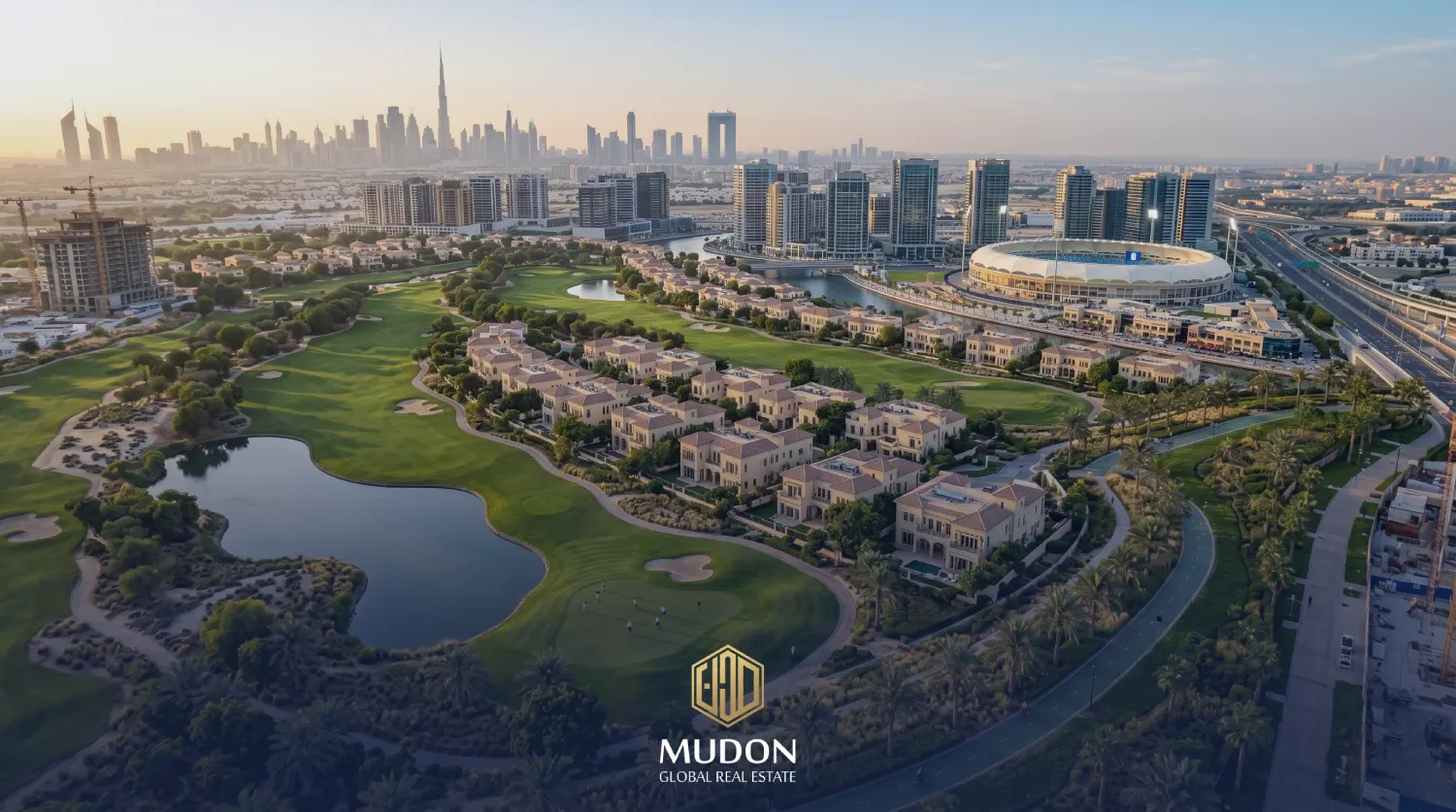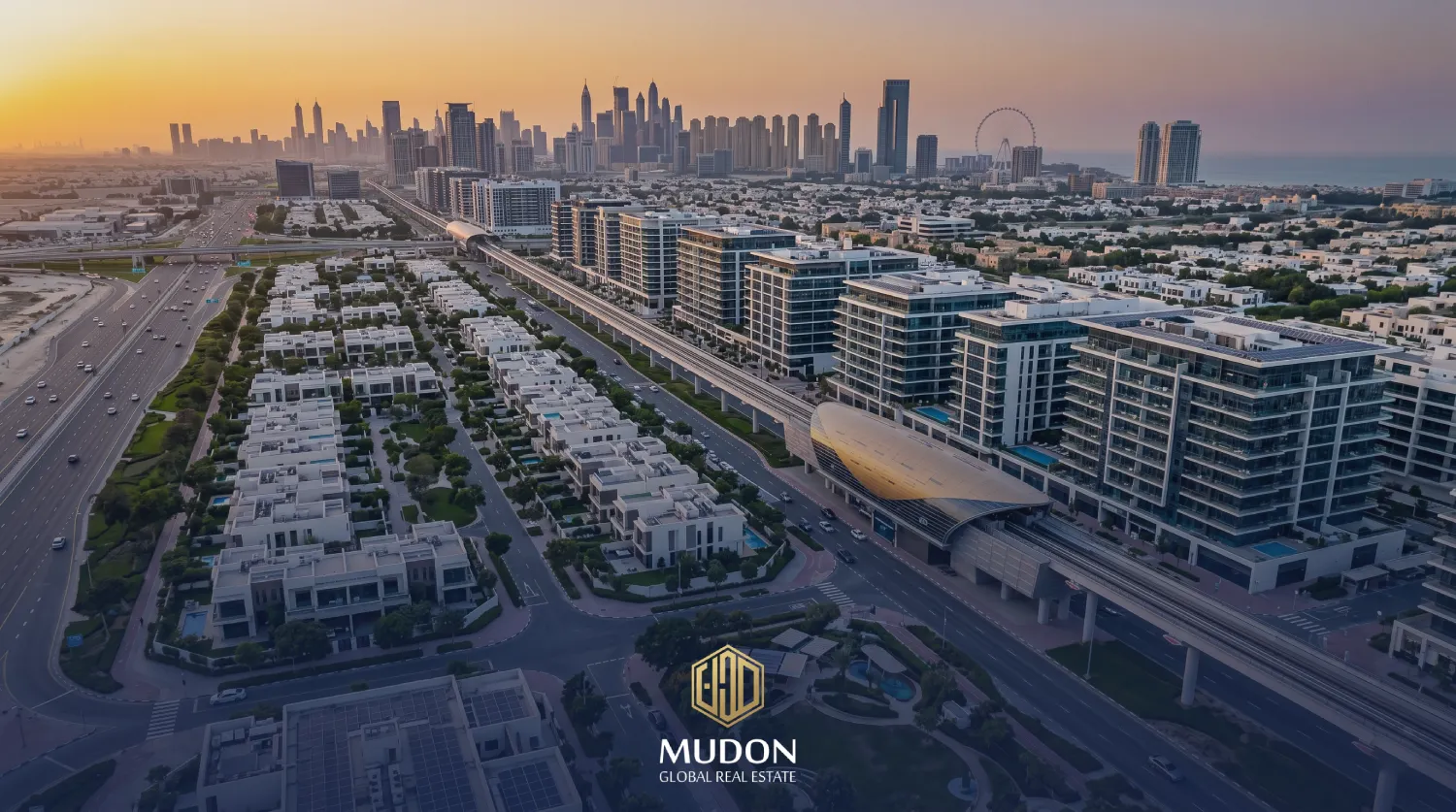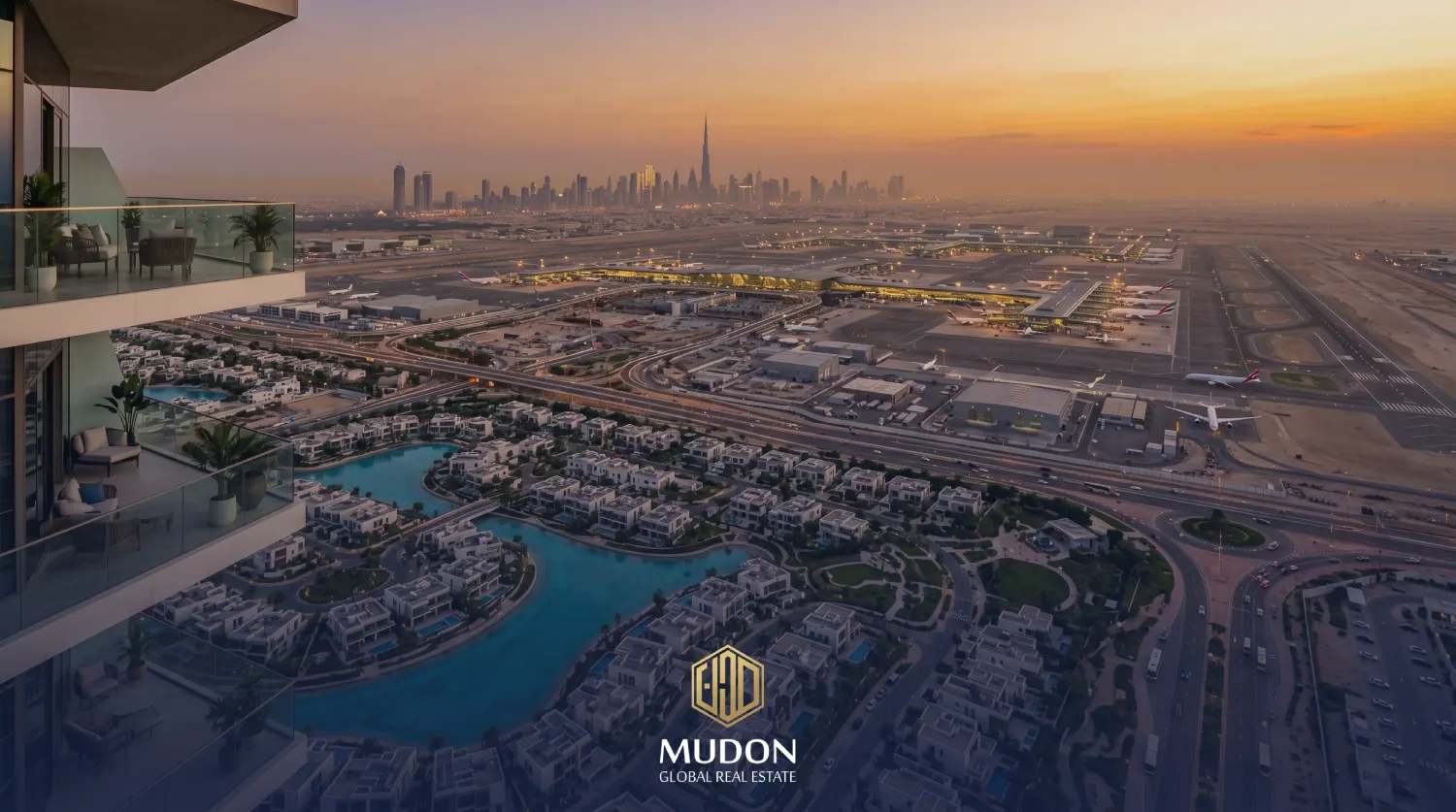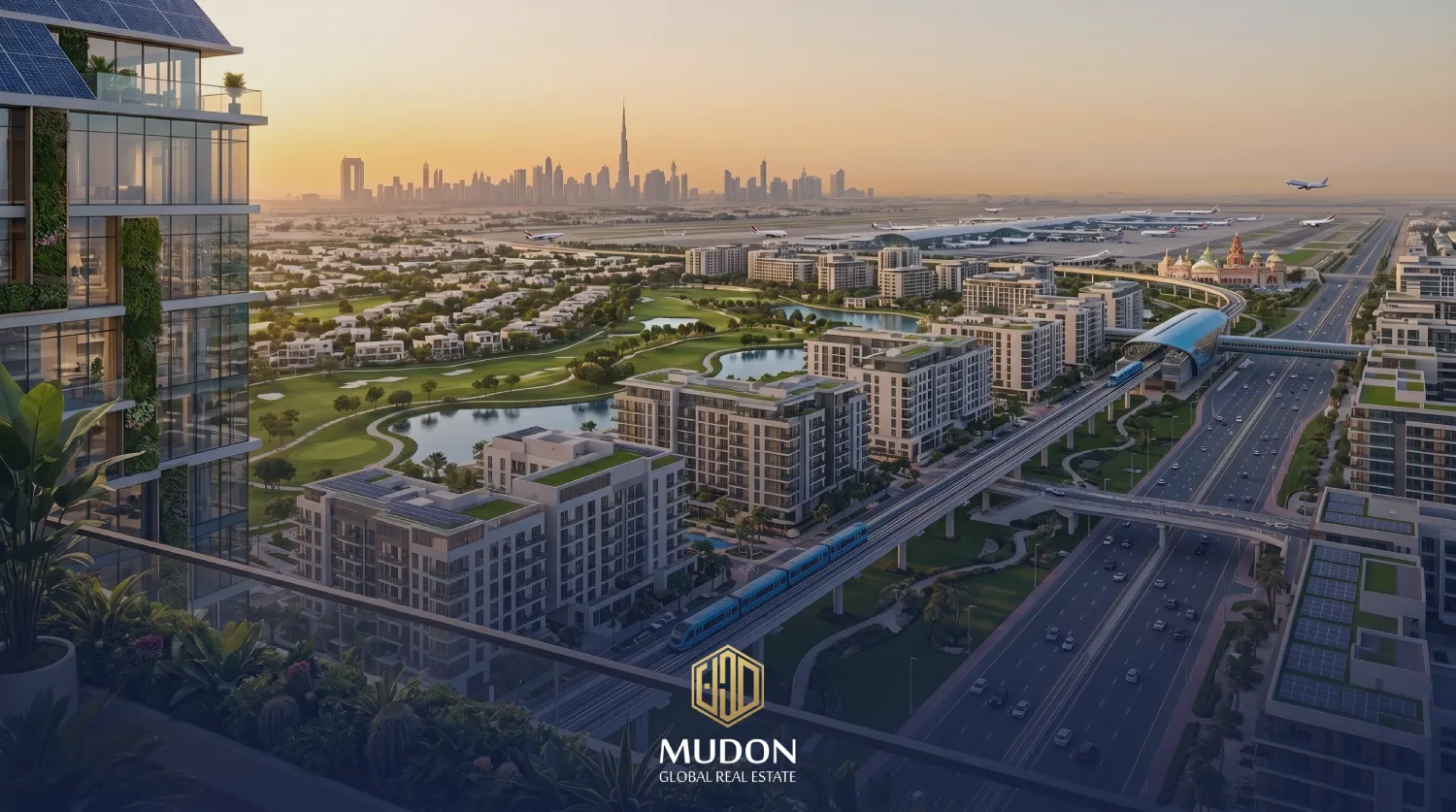
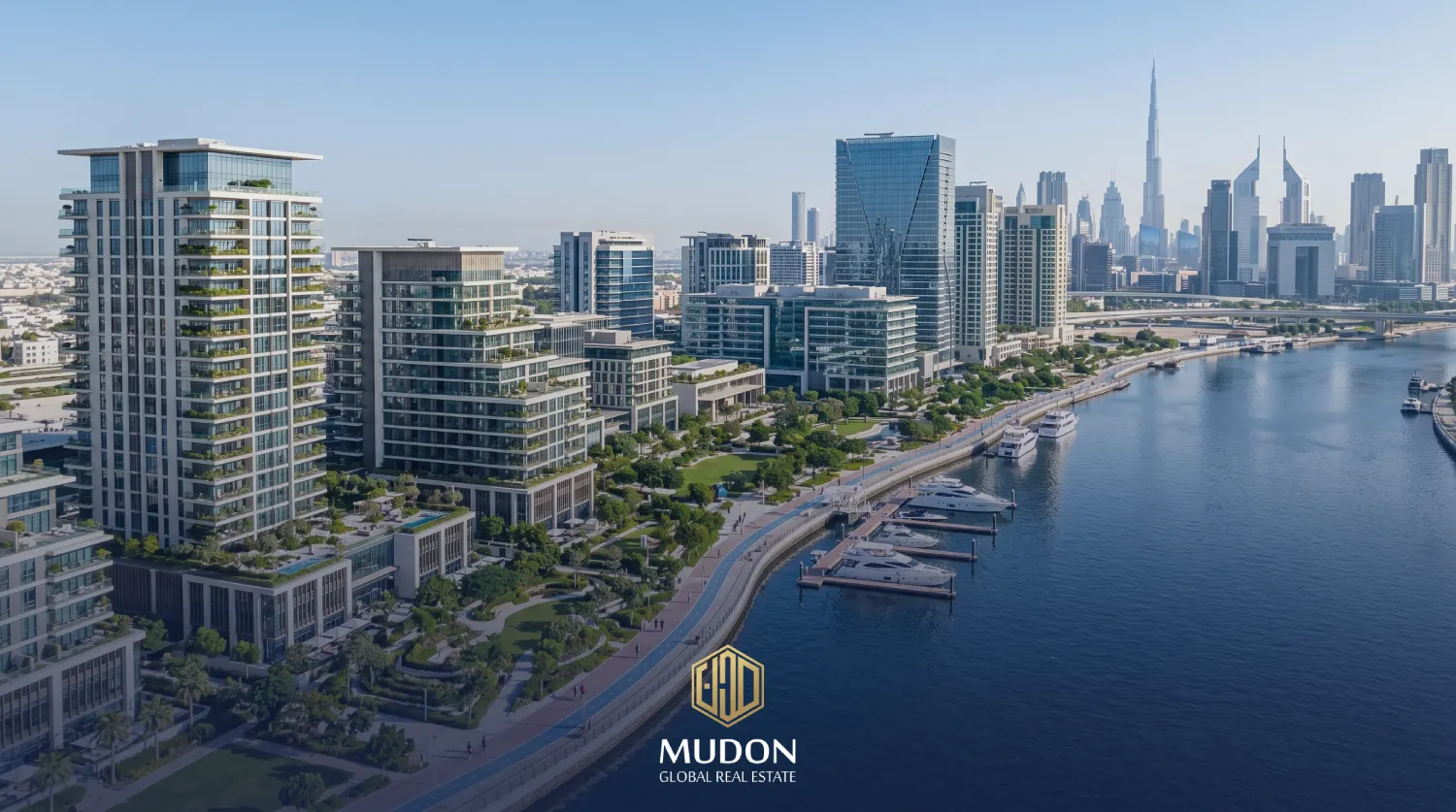
In the 2026 institutional real estate investment landscape, “smart liquidity” is moving away from saturated markets in search of “urban growth pockets” that combine robust economic drivers with a modern construction renaissance. Here, Dubai Science Park (DSP) stands out as one of the rare districts in Dubai to have evolved from a mere “specialized free zone” into a fully integrated luxury urban ecosystem.
As your wealth management and asset allocation advisors at Mudon Global, we present this comprehensive financial and operational report. The report is designed to break down the market dynamics of Dubai Science Park in 2026 and explain how investors can capitalize on the region’s profound demographic and construction shift to establish income-generating positions that deliver robust cash flow and rapid capital growth.
Table of Contents
Geographic and Economic Identity: “Dubai Science Park” as a Financial Moat and a Self-Sustaining Ecosystem
For the international investor or family offices watching Dubai from abroad, the name “Dubai Science Park” (DSP) often creates a psychological barrier; it suggests nothing more than a closed industrial zone or an isolated laboratory complex with no connection to residential real estate investment.
However, when this district is read through the lens of “financial valuation and demographic analysis” in 2026, a very different investment reality emerges.
The park is now classified as a “mixed-use economic hub” enjoying its most mature phase of real estate development. To understand how liquidity moves and valuations compound within this pocket, its identity must be broken down through the following institutional dimensions:
1. Institutional Backing and Sovereign Cover (The TECOM Umbrella)
Dubai Science Park does not operate as a random zone; it is the crown jewel in the portfolio of TECOM Group—Dubai’s largest quasi-sovereign business district management entity.
Investment Impact: TECOM’s presence as the area’s master developer gives investors a form of Sovereign Backing, ensuring that infrastructure—roads, smart power networks, and facilities—will not become obsolete, and that the district receives direct government support to facilitate foreign business operations. This institutional cover fully removes the emerging area risks.
2. The Economic Moat: The Geographic Monopoly on Knowledge
In the world of investment, the best properties are those surrounded by an economic moat that shields them from competition and market-cycle volatility. The park was established to serve as the region’s singular hub for highly resilient sectors: life sciences, biotechnology, renewable energy, and pharmaceuticals.
Recession-Proof Economy: Unlike tourism or retail sectors, which may be affected by economic cycles, healthcare, pharmaceuticals, and scientific research do not stop.
Critical Mass of Companies: This precise specialization has created a robust business environment that has attracted more than 400 multinational corporations (MNCs), including industrial giants such as Pfizer, Medtronic, Bayer, and AstraZeneca. The presence of these entities transforms the area from a mere real estate footprint into an economic center of gravity that cannot be easily displaced.
3. Engineering the “Captive Audience” and the Knowledge-Worker Economy
The golden rule in real estate is: “tenant quality determines yield quality.” The dense concentration of these global companies generates a substantial daily flow of a demographic segment known as “knowledge workers”—scientists, researchers, genetic engineers, energy consultants, and pharmaceutical executives.
High Solvency: This segment offers the landlord two decisive financial advantages: very high disposable income and near-complete job security.
Elite Localization: These experts work long hours in laboratories and offices and seek “luxury, comfortable housing” just minutes from their workplaces. They prefer renting premium apartments within the same district rather than wasting time commuting from elsewhere. This creates a geographically constrained, truly captive audience within the area.
4. The Financial Translation of Residential Assets: Inelastic Demand and Vacancy Immunity
The interaction between the “major pharmaceutical companies” and the “knowledge workers” produces a highly important financial phenomenon for property owners in Dubai Science Park: “inelastic rental demand”.
Immunity to Rent Volatility: Because these professionals have an urgent need to live close to their workplaces, they are less price-sensitive to annual rent increases.
Elimination of Turnover (Zero Tenant Churn): These professionals tend to settle into long-term contracts (2 to 5 years), sparing the owner the costs of tenant turnover—brokerage fees, interim maintenance, and vacancy periods.
Appeal of B2B Leases: This environment gives the sophisticated investor the ability to avoid leasing to individuals altogether and instead sign corporate lease agreements directly with biotechnology companies seeking luxury housing for incoming researchers or executives, thereby generating robust, guaranteed cash flow fully insulated from individual default risk.
The Mega-Catalyst: Urban Transformation and Repricing Engineering in 2026
In real estate cycles, capital valuations for districts only rise meaningfully when they experience a positive development shock; that is, when large-scale construction investment changes the area’s genetic identity and transforms it from a business district into a fully integrated lifestyle destination.
In 2026, Dubai Science Park (DSP) is undergoing this deep structural shift, powered by billions in macro-project liquidity that acts as a strong catalyst for re-pricing the entire district.
Below is the financial and operational breakdown of how these projects translate into direct gains for your portfolio:
1. Launching Mega-Structures: Creating an Urban Gravity Mass
For years, the district lacked iconic residential projects that matched the stature of the global companies based there. That reality has changed dramatically with the launch of mega-structures that do not merely build apartments, but create vertical mini-cities, led by Binghatti Hills, the largest residential development in the area’s history.
The Concept of “Gravity Mass”
A project the size of Binghatti Hills (with thousands of residential units and amenities comparable to the world’s largest resorts, including Olympic-size pools and artificial beaches) does not enter the market quietly; it creates an enormous gravity mass.
This construction scale forces infrastructure, major brands, and investment liquidity to cluster around it, turning the entire district into a new anchor point on Dubai’s residential map.
Financial Translation – The Repricing Effect
This is the most important mechanism for the early investor. When a major developer enters and launches an ultra-luxury project at a price per square foot (PSF) above the area’s historical average, it creates a new price benchmark. That benchmark triggers a positive shock that lifts the prices of all surrounding assets (the rising tide lifts all boats).
Owners who bought in the area at lower prices in the past find that their assets have suddenly been marked up based on the new pricing established by the mega-project, delivering substantial and rapid unrealized capital gains.
2. Retail and Lifestyle Maturation (Lifestyle Integration): Engineering the 15-Minute City
The second transformation Dubai Science Park is witnessing in 2026 is its shift from a daytime destination (a 9-to-5 working environment) into a 24/7 living community.
Urban Integration
Residents of the district, as well as the medical and research professionals working there, no longer need to endure the hassle of driving to Dubai Hills or Al Barsha in search of leisure or shopping.
Premium retail, community malls, fine-dining concepts, and wellness centers have been integrated into the ground floors and podiums of the major residential projects.
Direct Financial Impact – The “Livability Index”: In institutional real estate valuation, the higher the livability index (the resident’s ability to meet all leisure and daily needs on foot), the higher the property value. This retail maturation translates financially into two decisive outcomes for the owner:
Justifying Rent Premiums: Tenants are willing to pay a lifestyle premium to live in a fully serviced community, allowing the owner to command rental margins above the market average.
Maximizing Tenant Retention Rate: Service integration removes the tenant’s desire to relocate. That stability reduces turnover and vacancy to zero, ensuring uninterrupted cash flow and maximizing the portfolio’s annual net return.
Infrastructure and Arterial Connectivity: The Central Node and Frictionless Logistics Engineering
In modern real estate investment theory, smart markets have abandoned distance measurements in kilometers and replaced them with the concept of “time to access and flow efficiency”. A property’s value is derived not only from the quality of its internal concrete, but from how structurally connected it is to the emirate’s vital arteries.
Dubai Science Park (DSP) is a stringent example of a central geographic node; positioned in the heart of New Dubai as a highly liquid logistics platform, it gives its real estate assets geographic immunity that lifts their intrinsic value through two primary operational channels:
1. Geographic Arbitrage and the “Price Versus Proximity” Equation
The district enjoys an exceptional strategic location beside one of Dubai’s most expensive and fastest-growing residential areas, Dubai Hills Estate. This positioning creates a golden opportunity to apply a geographic arbitrage strategy:
Spillover Capture
As prices and PSF levels in Dubai Hills rise to record levels that may compress net yield margins for new investors, Dubai Science Park becomes the natural outlet for investment liquidity and rental demand. The district offers tenants and buyers the same lifestyle and central location, but at a competitive price discount that maximizes return on investment (ROI).
The 15-Minute Matrix
The district sits at the center of a road network that places it equidistant from Dubai’s financial, business, and tourism hubs. Within just 15 minutes, a resident can reach Downtown Dubai and the financial center (DIFC) to the north, or Dubai Marina and the beachfront districts to the southwest.
Attracting “Affluent Professionals”
This dual proximity makes the area the first residential choice for executive professionals working in Dubai’s major economic centers, who are seeking modern communities that allow them to reach their workplaces without spending hours commuting, ensuring a steady flow of high-quality rental demand.
2. RTA CAPEX Surge: Immediate Infrastructure Premium
The capital value of any real estate district is directly linked to the scale of government spending on its infrastructure. In 2026, Dubai Science Park is benefiting from the largest road development packages executed by the Roads and Transport Authority (RTA) to develop Dubai’s central corridors:
Expansion and upgrading of Hessa Street and Umm Suqeim Street corridors: These multi-billion-dirham projects, completed in 2026, transformed these arteries into fully free-flowing roads through advanced overpasses, additional lanes, and the upgrading of critical intersections.
Ingress & Egress Fluidity: Many emerging districts in Dubai have historically suffered from the problem of bottlenecks at entry points. Dubai Science Park is structurally superior, with multiple direct exits onto Al Khail Road (E44) and Umm Suqeim Street, and more recently benefiting from the exceptional smoothness of Hessa Street. This means traffic flow to and from the residential communities inside the district is now a thing of the past.
Financial Impact – The “Infrastructure Premium”: Reducing traffic congestion and improving circulation around the district translates immediately into two decisive outcomes for the real estate portfolio:
- Automatic Increase in Annual Rental Value: A tenant in Dubai is always willing to pay extra for a property that guarantees smooth ingress and egress without wasted time.
- Maximizing Tenant Retention Rate: Frictionless logistics prevent residents from even considering relocation to other areas, increasing cash-flow stability and protecting the owner from hidden vacancy costs.
Micro-Geography in Dubai Science Park: Deconstructing Asset Communities and Portfolio Engineering
From the perspective of aggregate real estate economics, treating the property supply in Dubai Science Park (DSP) as a single homogeneous block is a strategic error that leads to mispriced returns.
Smart capital allocation in 2026 requires a micro-geographic breakdown of the district according to asset architecture, because the design philosophy and scale of each project determine its monetization strategy and the quality of cash flow it produces.
The residential supply in the district is divided into two financial segments that operate on different but complementary profit mechanisms within the investment portfolio:
1. Mega-Structures & Resort Living: Engineering Density and Supercharged Cash Flow
This segment represents the face of the district’s modern construction boom in 2026, led by the area’s largest vertical developments such as Binghatti Hills and similar communities designed to operate as self-sustaining mini-cities.
Asset Engineering and Amenity Monetization
The development philosophy here is based on smart density and mega-blocks.
The investor is not merely buying residential space here; they are acquiring a stake in a fully integrated leisure resort with 20 to 30 exclusive amenities: artificial beaches, Olympic-size pools, suspended jogging tracks, hotel-standard tennis courts, and co-working hubs.
This design turns the building into a demographic magnet that absorbs demand from its surroundings.
Demand Profile (The Transient & Tech Demographic)
This segment directly targets high-income young professionals, technical consultants visiting the district’s companies, digital nomads, and tourists seeking upscale stays near the congestion-free Umm Suqeim corridor.
Financial Behavior and Profit Mechanism (Yield Farming)
These assets are the ideal instruments for a short-term rental (Holiday Homes) and dynamic pricing strategy. The density of hotel-style amenities gives these units a decisive advantage over platforms such as Airbnb; visitors often prefer booking an apartment here over a conventional hotel.
This strategy allows returns to be maximized during Dubai’s peak seasons, generating net yields exceeding 8.5% to 10% annually—an excellent tool for producing fast cash flow, despite its cyclical sensitivity.
2. Boutique & Thematic Residences: Defensive Hedging and Wealth Preservation
At the other end of the investment spectrum are mid-rise towers with distinctive architecture and superior quality, represented by developers specializing in classical and Victorian-inspired designs (such as the Vincitore series, including Aqua Dimore and Dolce Vita) and luxury compact towers such as Skyhills.
Asset Engineering and Architectural Differentiation
These projects are built on a philosophy of scarcity and prestige. They feature European-inspired facades drawn from the Victorian era or modern-classic designs, with a strict focus on handcrafted interior finishes, private plunge pools within apartments, and integrated lush gardens.
The design here is intended to create intangible value that shields the asset from price obsolescence.
The Operational Driver and Tenant Profile (The Corporate Executive Class)
The main magnet here is the segment of permanent experts, scientists, surgeons, and executives of major global pharmaceutical companies based in the district (such as Pfizer and Bayer). This family-oriented segment seeks privacy, calm, and architectural distinction, and rejects living in high-density communities.
Financial Behavior and Portfolio Stability (Capital Preservation)
This segment is classified as a capital-preservation defensive asset. The optimal strategy here is long-term annual leasing (1 to 3 years), often through corporate lease agreements paid directly by companies on behalf of their employees.
This segment delivers stable net rental yields ranging between 7% and 8%, with complete immunity to tourism-season volatility and very strong capital appreciation at exit, given that the uniqueness of the design protects the property from price competition in the secondary market.
Financial Allocation Matrix for the Sophisticated Investor (Dubai Science Park 2026)
| Financial and Strategic Indicator | Mega-Structures Segment | Boutique and Thematic Segment |
|---|---|---|
| Common Asset Model | Mega resort towers (high density) | Mid-rise buildings (exclusive designs) |
| Portfolio Financial Objective | Maximize immediate cash flow and liquid liquidity | Wealth preservation and sustainable capital growth |
| Optimal Operating Mechanism | Short-term rental management / holiday homes | Stable annual leasing / corporate contracts (B2B) |
| Nature of Demographic Demand | Tourists, young professionals, visiting consultants | Executives, scientists, resident families |
| Expected Net ROI | 8.5% – 10% (dynamic pricing) | 7% – 8% (protected cash flow) |
| Tenant Turnover Rate | High (requires professional operational management) | Very low (long-term operational stability) |
| Hedge Advantage | Full flexibility to shift into annual leasing | Protection from price declines due to design distinctiveness |
Financial Analysis and the Language of Numbers in Dubai Science Park 2026: Arbitrage Engineering and Performance Indicators
In institutional real estate investment theory, the most profitable decisions are built on capturing assets undergoing valuation arbitrage; this is the condition in which properties trade at a material discount to their intrinsic value because the market has not yet fully priced in the completion of infrastructure and surrounding projects.
Dubai Science Park (DSP) is the most prominent arena in Dubai’s 2026 financial cycle for applying this strategy; it offers investors high margins of safety and exceptional ability to de-risk while generating attractive returns compared with neighboring districts.
Below is the expanded analytical breakdown of the district’s financial data and operational indicators:
1. Entry Points and Bulk Allocation Tactics
The pricing structure of Dubai Science Park in 2026 is highly flexible, enabling family offices and individual investors to establish strong financial positions with efficient capital deployment:
Integrated Asset Price Range: Prices for compact apartments (hotel-style luxury studios) in new 2026 projects start from AED 850,000 to AED 1,000,000, while one-bedroom units (1BHK) range between AED 1.2 million and AED 1.5 million.
Bulk Buying Engineering: This competitive price barrier opens the door to a fragmented capital deployment strategy. Instead of locking AED 4 million into a single ultra-luxury asset in a central downtown area (which may carry concentration risk and lower yield), this pricing range allows the investor to acquire a portfolio of 3 to 4 compact units in the science park.
Operational Risk Deconstruction: Spreading liquidity across several units ensures tenant diversification within the portfolio (for example, renting to employees from different pharmaceutical companies), protecting the investor’s aggregate cash flow. A temporary disruption in one unit’s income does not affect the stability of the others, while flexible payment plans during construction help maximize automatic leverage.
2. Price Per Square Foot (PSF) and Price Convergence Theory
The strongest mathematical driver of capital growth in Dubai Science Park lies in the pricing discount gap between it and its direct neighbor, Dubai Hills Estate:
The Discount Gap: The average price per square foot for premium, modern projects in Dubai Science Park ranges between AED 1,500 and AED 1,800. By contrast, comparable projects in Dubai Hills Estate exceed AED 2,400 per square foot, despite both areas sharing the same central geography, logistics access, and equal proximity to the main road network.
Spatial Convergence: These figures mean that Dubai Science Park assets are currently trading at a strategic capital discount of 25% to 30%. According to real estate economics theory, this discount is a temporary pricing distortion caused by the time lag in delivering mega-structures such as Binghatti Hills.
Unearned Equity Capture: As construction progresses and major handover dates in 2026–2027 draw closer, alongside the maturation of the retail segment, prices in the district are expected to converge with Dubai Hills pricing. This narrowing price gap automatically converts into rapid net capital appreciation that accrues to the net worth of the sophisticated investor who secured the asset during the discount phase.
3. Rental Liquidity Quality and Corporate Lease Immunity (Corporate B2B Leasing)
The resilience of a real estate asset is measured not only by yield, but by the safety and reliability of the party committed to paying that yield. Here, Dubai Science Park stands out for its exceptionally high-quality rental liquidity:
Shift Toward B2B Leases: Rental demand in the district is not random consumer demand dependent on individuals whose financial stability may be affected by economic conditions. The presence of more than 400 global life sciences and energy companies (such as Pfizer and Bayer) creates fertile ground for direct institutional leasing.
Zero Default Risk: Many of these multinational companies prefer to acquire blocks of luxury or compact apartments near their offices to allocate as permanent housing for their imported experts, scientists, and executives. In this case, lease contracts are signed directly between the owner and the company (Business-to-Business).
Cash Flow Stability: Institutional leases are characterized by long durations (typically 2 to 5 years), no collection complications, and lower maintenance and wear-and-tear costs due to the discipline of corporate employees. This model fully shields your real estate portfolio from individual market volatility and ensures net cash flow with the highest level of sustainable financial security.
Environmental and Social Governance (ESG): Turning Environmental Sustainability into a Financial Lever and Operational Asset
In modern investment accounting in 2026, assessing ESG compliance is no longer a luxury or a public-relations tool; it has become a key financial determinant that directly affects cash-flow quality and exit value.
Dubai Science Park (DSP) cannot be separated from its strict environmental and scientific identity; the district is home to research companies and life labs that naturally impose exceptionally high sustainability standards.
Buying a property asset here means automatically participating in a smart ecosystem that translates green standards into tangible profits and risk buffers through the following operational and financial channels:
1. Smart Engineering and OPEX Reduction (OPEX Optimization & Net ROI Protection)
Modern construction projects in Dubai Science Park (such as mega towers and luxury boutique residences) rely on a strict environmental building code that complies with global LEED certifications (Leadership in Energy and Environmental Design).
Cost-Reduction Mechanisms (Green Engineering)
Smart glass facades with low thermal permeability, motion-sensor LED smart grids, and highly efficient centralized cooling and air-conditioning systems connected to AI-powered building management systems (AI-BMS) are integrated.
In addition, advanced water-recycling technologies are applied for irrigating the projects’ extensive green areas.
Financial Impact on Service Charges
In conventional real estate, energy bills for shared facilities (corridors, pools, lobbies) are the greatest threat to net returns, as they raise annual service charges borne by the owner. In the science park, reducing resource consumption by 35% to 45% results in a sustained and measurable reduction in annual service charges.
Every dirham saved on maintenance expenses goes directly into the net rental return, protecting the portfolio’s cash flow from erosion.
2. Scope 3 Emissions Compliance and Direct Real Estate Negotiation Power (B2B Leverage)
This is the most sophisticated legislative aspect, unknown to many individual investors, yet it is the foundational pillar of major investment funds:
The Legal Dilemma for Global Companies
Global pharmaceutical companies and biotechnology giants based in the district are subject to stringent international audits and to the Federal Decree on Mandatory Sustainability Reporting, in line with the UAE’s 2050 climate neutrality strategy.
These companies are legally required to reduce Scope 3 emissions—indirect emissions that include the carbon footprint of supply chains, office premises, and employee housing.
Turning Compliance into Negotiating Power for the Owner
When a major pharmaceutical company (such as Pfizer or Bayer) relocates hundreds of its scientists or regional executives to Dubai, it cannot legally house them in conventional towers that consume excessive energy, because that would damage the company’s annual sustainability report and expose it to fines or a downgrade in its credit rating.
Monopoly of Corporate Demand (Corporate Leases)
Owning an ESG-compliant, environmentally certified asset within the district gives you absolute monopolistic negotiating power. Your assets become the default choice for signing exclusive corporate leases, away from individual-market volatility. This mechanism allows you to command a green premium on rent and secure long-term contracts (3 to 5 years) that ensure complete vacancy elimination.
3. Superior Exit Liquidity and the Appeal of “Patient Capital” (Institutional Exit Strategy)
The third financial dimension of ESG relates to the exit strategy when the investor decides to monetize assets and turn capital gains into realized returns:
Magnet for REITs: Major real estate investment trusts, as well as European and Asian family offices deploying capital into Dubai in 2026, have internal mandates that prohibit them from buying any property that is not ESG-compliant.
Ease of Secondary-Market Monetization: Investing in environmentally friendly Dubai Science Park properties ensures that your assets will always enjoy superior secondary-market liquidity, because they match the global standards these institutional funds seek when balancing their carbon portfolios. This makes it easier to sell quickly and at the highest possible capital valuation whenever an exit is required.
Start Your Investment Journey: Contact the Experts at Mudon Global
Securing high-yield strategic assets with confirmed price arbitrage in Dubai Science Park requires measured action and precise financial guidance.
Whether you are seeking to allocate liquidity into off-plan mega projects to capture capital growth, or to acquire ready assets that generate immediate cash flow supported by major global companies, the advisory and wealth management team at Mudon Global is ready to provide full executive support.