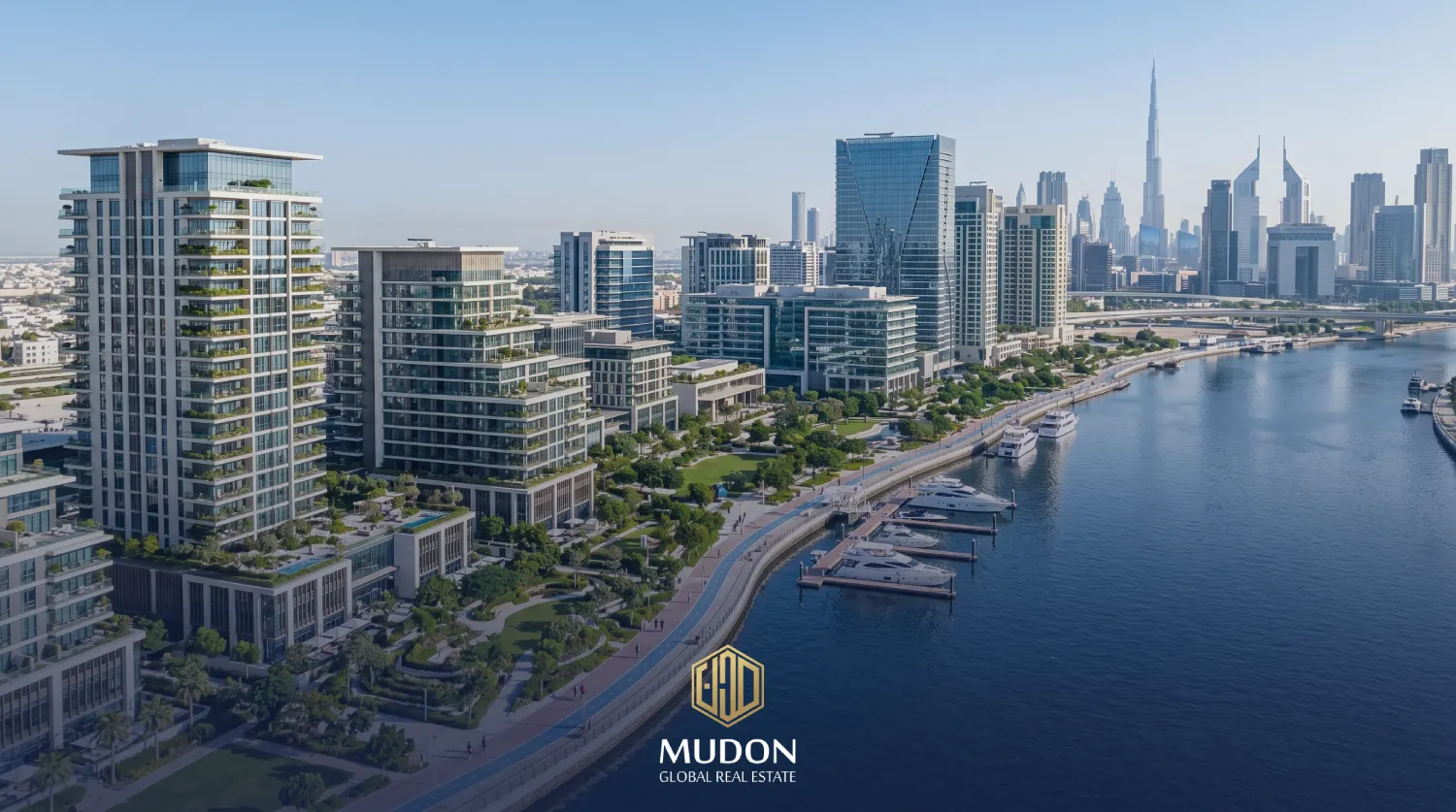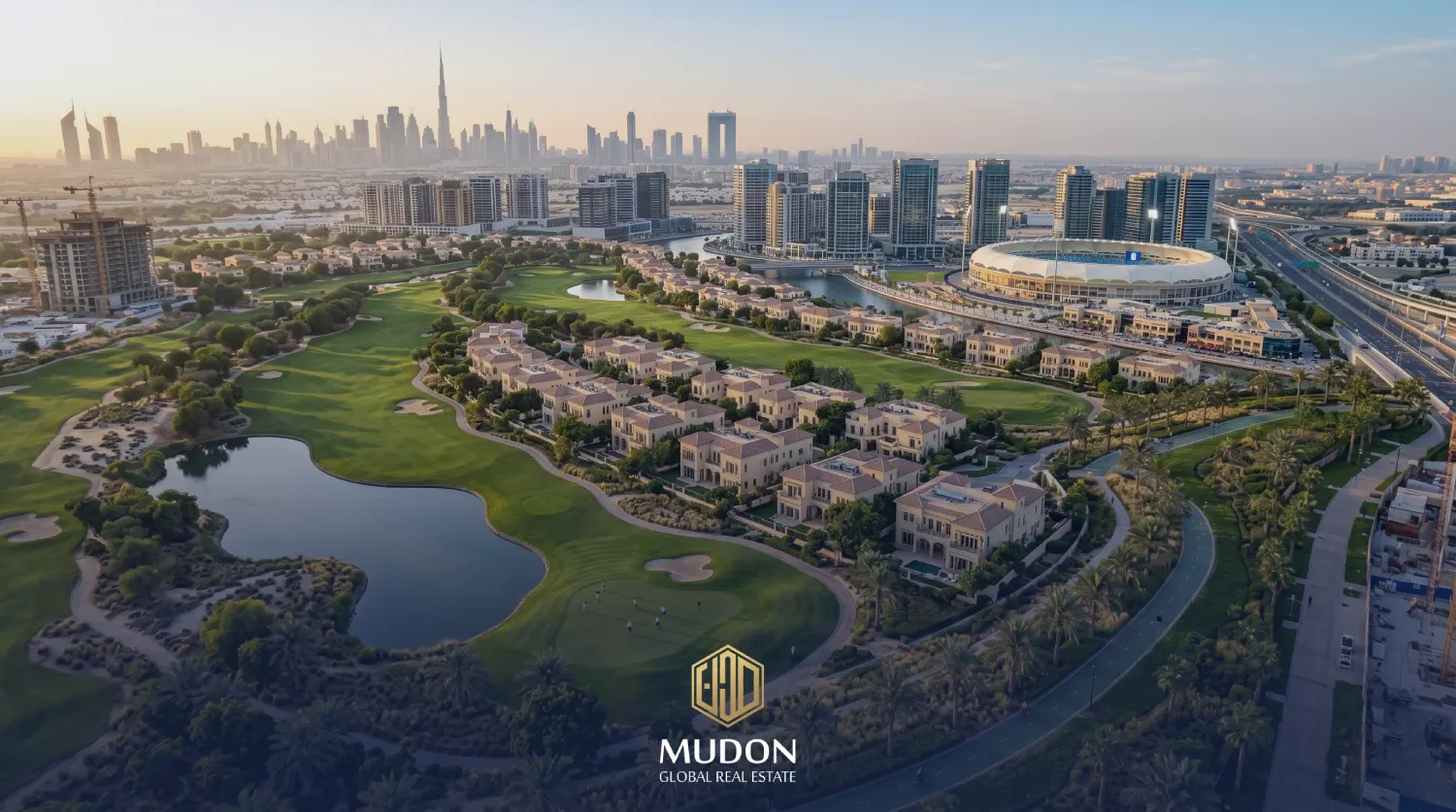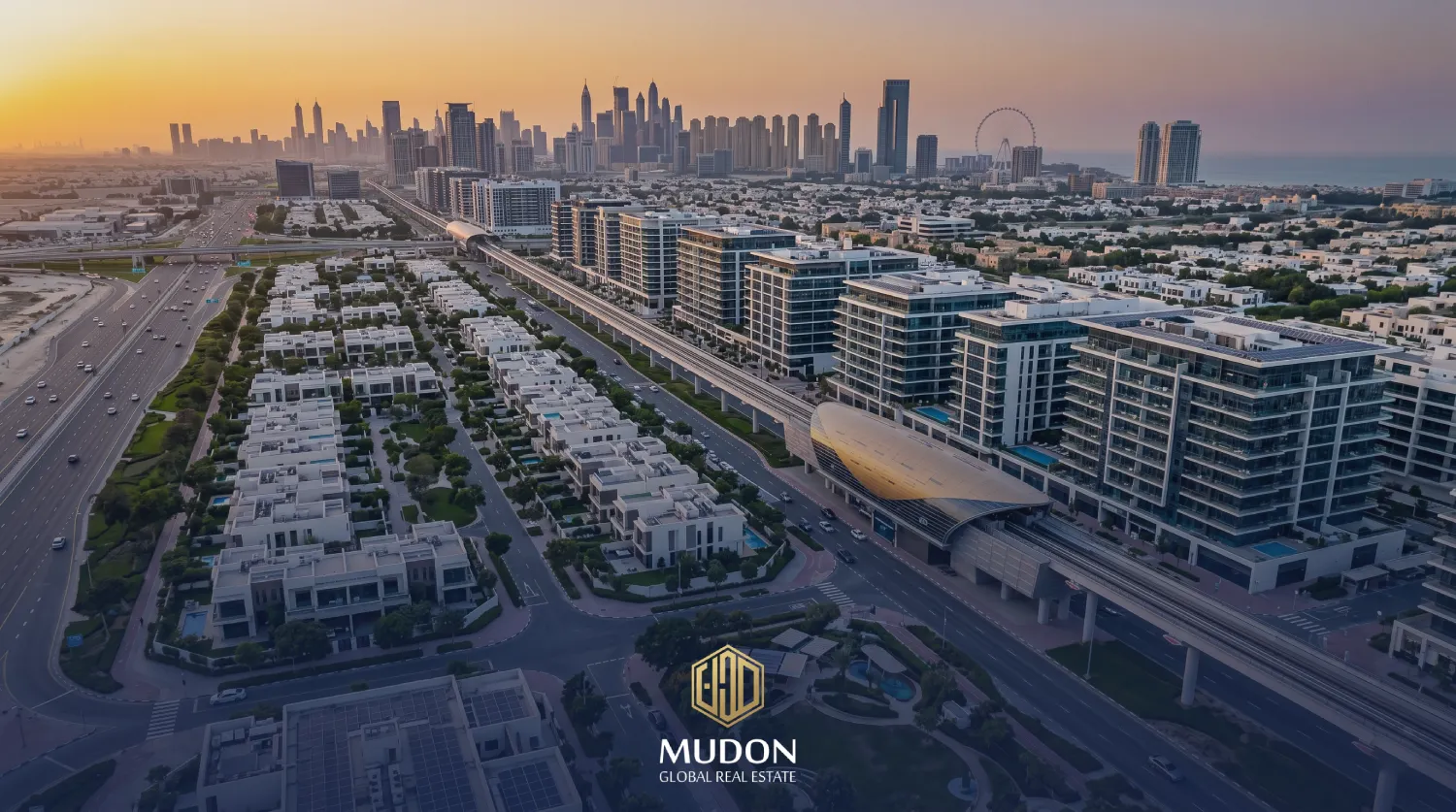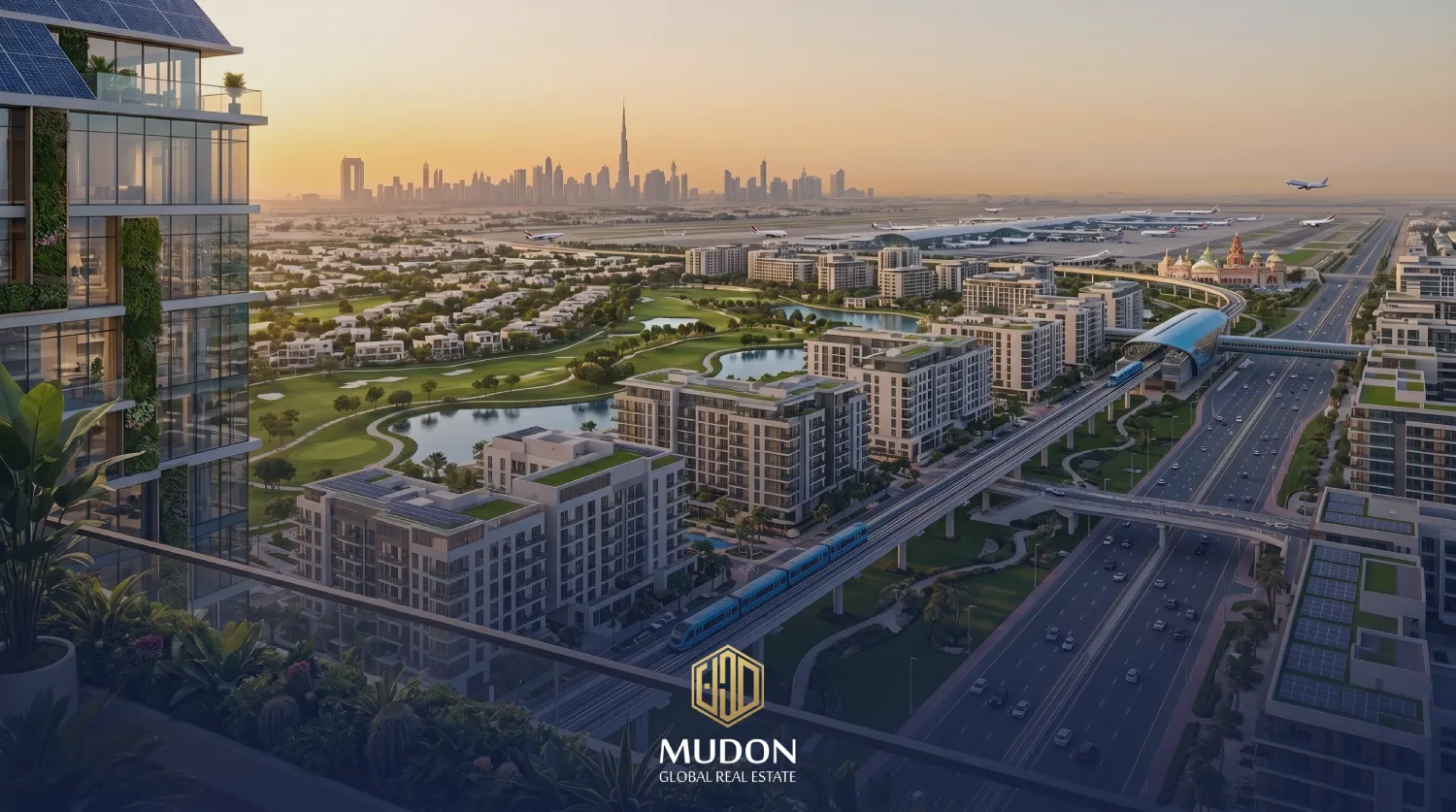
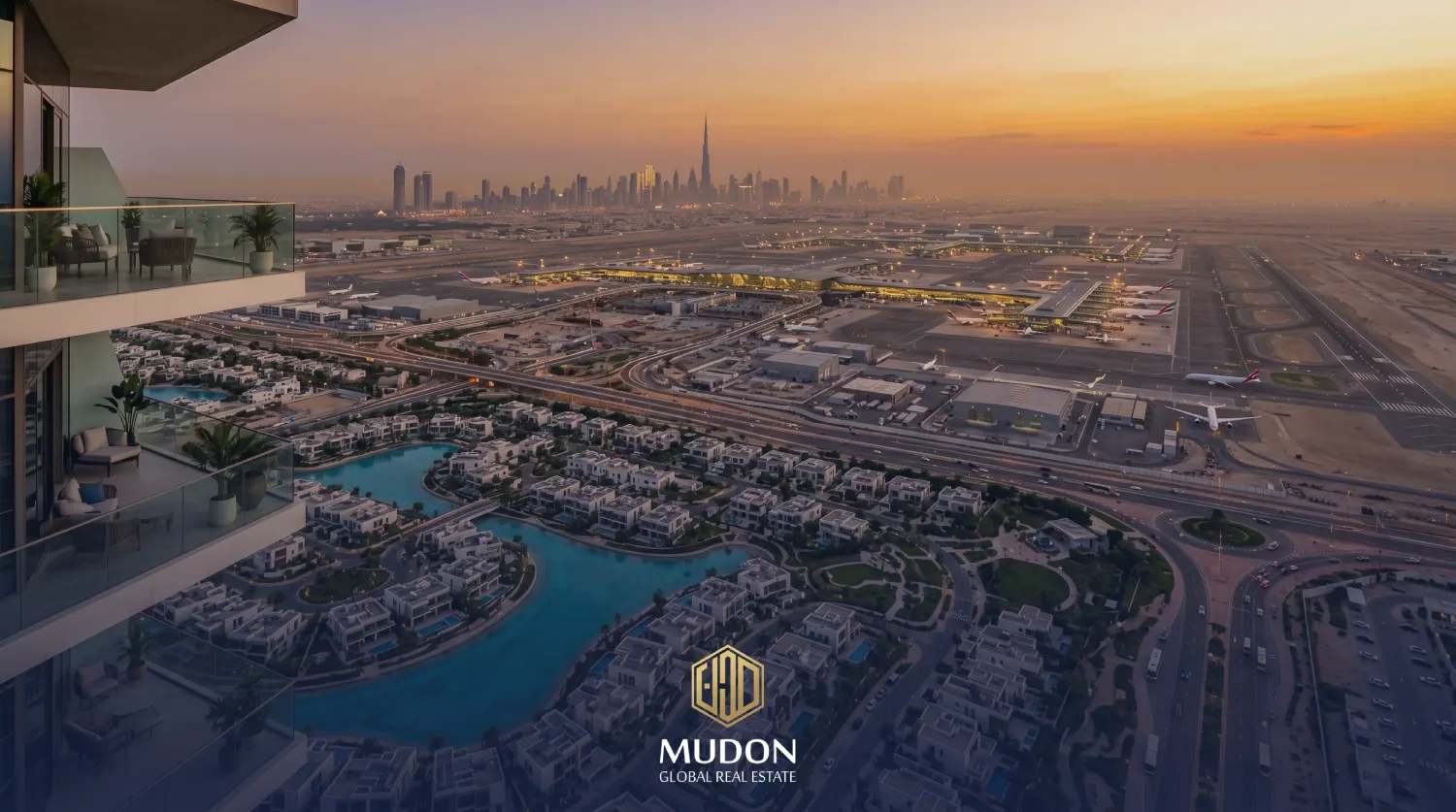
As institutional capital continues to seek safe economic moats and refuges that ensure maximum capital efficiency, the analytical data of Dubai’s real estate market in 2026 shows a strict strategic orientation toward “Dubai South”.
This area is no longer merely a distant logistics extension; it has become the “new economic center of gravity for the Emirate of Dubai”, driven by the world’s largest investment in aviation infrastructure.
As your wealth and asset allocation advisors at Mudon Global, we place in your hands this comprehensive financial and operational report.
This report aims to unpack the market mechanics in “Dubai South” for 2026, and to explain how family offices and individual investors can benefit from “valuation arbitrage” gaps to establish financial positions that combine inevitable capital appreciation with strong cash flows.
Table of Contents
Geographic and Economic Identity: What is “Dubai South” from the Perspective of Institutional Capital?
For the international investor or family office entering Dubai for the first time, “Dubai South” is often mistakenly viewed as merely a logistics zone or an industrial extension on the city’s outskirts.
Yet in the 2026 financial and valuation lexicon, this area is classified as the “world’s first and largest integrated airport city (Aerotropolis)”, and the largest sovereign urban project in the Emirate’s history.
To understand this area strategically before allocating any liquidity, its identity must be unpacked across three structural pillars:
1. The Macro-Scale Geographic Scope (Macro-Scale Development)
Dubai South spans a vast area of 145 square kilometers (14,500 hectares). To appreciate this financial and geographic scale, the area is equivalent to twice the size of Manhattan Island in New York, and it has been engineered to accommodate more than one million residents and support 500,000 jobs upon completion.
The area sits in Dubai’s far south and is strategically positioned to serve as the direct land bridge to the capital, Abu Dhabi.
2. The Economic Model: An Integrated Functional-Zone Cluster (Integrated Aerotropolis)
From an investment perspective, Dubai South is not merely a collection of random residential developments; it is a “closed and self-sustaining economic system” divided into 8 integrated functional zones. This umbrella includes the logistics district, aviation district, residential district, luxury golf communities, and the Free Zone, as well as the beating heart, “Expo City Dubai.”
This means that residential real estate here is underpinned by a vast commercial ecosystem that generates rental demand organically and continuously.
3. Sovereign Infrastructure Peg
Dubai South differs from the rest of Dubai in that the valuations of its assets do not depend on marketing campaigns or individual speculation, but are structurally tied to “sovereign government spending”. The real estate assets here are directly linked to the growth of the Middle East’s largest logistics corridor (Al Maktoum International Airport DWC and Jebel Ali Port).
Buying an asset here effectively means buying a hedged stake in the infrastructure of Dubai’s economic future over the next three decades.
The Mega-Catalyst: The Airport City Economy and Sovereign Growth Catalysts for 2026
In macro-finance, the safest investment decisions are built on tracking sovereign CAPEX. When governments inject billions of dollars into a defined geographic area, they create an economic moat that protects surrounding assets from ordinary market volatility and ensures inevitable capital growth.
Dubai South’s exceptional appeal in 2026 stems from three structural drivers working in parallel to reshape the Emirate’s real estate demand map:
1. The AED 128 Billion Expansion of Al Maktoum International Airport (DWC): Engineering Inelastic Demand
The approval of a AED 128 billion (USD 35 billion) sovereign budget to expand Al Maktoum International Airport into the world’s largest, with a capacity of 220 million passengers and 400 aircraft gates, represents the largest real estate catalyst in Dubai’s modern history.
The Operational and Demographic Impact (The Ripple Effect)
In 2026, as the major construction packages for the new terminals enter full execution, the market has begun to register a gradual and sustained migration of global airline operations. Relocating these operations necessarily means relocating tens of thousands of pilots, cabin crew, aviation engineers, and senior administrative staff.
Establishing Inelastic Demand
This large human concentration creates “inelastic” rental demand; these professionals are required to live within a geographic radius of no more than 15 minutes from the airport gates. Positioning capital in Dubai South real estate today ensures the investor captures this massive institutional demand, transforming residential assets into investment instruments that are insulated from slowdowns in other markets.
2. Construction Liquidity Injection and Commitment Confirmation (Deliveries 2026 – 2028): Eliminating Execution Risk
The biggest concern for international capital and family offices when acquiring off-plan assets is “delivery risk.” Dubai South excels here by providing strict execution assurances that shield the area from any economic uncertainty.
Actual Construction Momentum (Q2 2026)
At the start of May 2026, Dubai South’s executive management (led by CEO Nabil Al Kindi) sent an exceptionally strong institutional confidence signal to the market by awarding large construction contracts worth AED 2 billion to advance later phases of the “Hayat by Dubai South” project.
Attracting Patient Capital
The launch of these construction works in Q2 2026 for delivery of integrated communities in 2028 effectively eliminates speculative noise and confirms that the master developer has sufficient solvency and liquidity for immediate execution.
This disciplined commitment attracts investment funds seeking safe assets with reliable and guaranteed delivery schedules.
3. The Dual Logistics Corridor (Sea-to-Air Hub): Generating Institutional Leases
Dubai South does not rely on passenger traffic alone; it is the only urban node globally that directly links the Middle East’s largest seaport (Jebel Ali Port) and the largest future airport within a unified customs and logistics corridor.
Multinational Corporation Migration (MNCs Consolidation)
This arterial integration is driving major global freight companies, e-commerce giants, and advanced technology manufacturers to consolidate their regional headquarters and large warehousing facilities within Dubai South Free Zone.
The Shift Toward Corporate Leasing (Corporate Leasing)
This commercial movement is fundamentally changing the tenant profile in the area. Instead of dealing with individual tenants, the location gives a property owner the opportunity to sign long-term corporate leases with major companies seeking pooled accommodation for their managers and staff.
These leases are characterized by the absence of default risk and near-zero vacancy rates, giving your real estate portfolio stable, high-quality cash flows.
Regulatory Catalysts and Commercial Integration: Incentive Packages and the Impact of Free Zone-Mainland Integration
In the financial doctrine of institutional portfolios, a decision to allocate liquidity to the residential sector is not made until the presence of a “solid commercial engine” has been verified to ensure sustained tenant flow and payment capacity.
Dubai South is entering an exceptional phase of maturity driven by two regulatory developments that completely change the rules of the economic game and transform the area from a mere logistics hub into a fully integrated business ecosystem:
1. Administrative and Financial Incentive Package: Reducing the Cost of Establishing Business Hubs
Dubai South Free Zone’s executive authority has launched a strategic incentive package specifically designed to reduce companies’ operating expenses (OPEX) and facilitate the attraction of foreign capital.
- Operational Mechanism: The package includes full exemptions from administrative late-payment penalties, as well as substantial reductions in the fees for setting up new entities and the costs of renewing trade licenses.
- Economic Impact: This direct reduction in financial barriers to establishment supports business continuity for existing companies and accelerates the pace of attracting startups and small and medium-sized enterprises (SMEs) seeking a flexible and cost-efficient business environment for launching their regional operations.
2. Dual Structural Integration (Free Zone – Mainland Integration): Eliminating Bureaucratic Friction
In parallel with the financial incentives, Dubai South is benefiting from the practical implementation of Executive Council Resolution No. 11 of 2025, the most important legislative development in the Emirate’s business operating structure.
- Operational Flexibility: This resolution allows companies in Dubai’s free zones to conduct their commercial and operational activities directly in the Emirate’s Mainland, without the complexities of establishing a separate local legal entity or incurring duplicate licensing fees.
- Eliminating Commercial Boundaries: This integration gives multinational corporations (MNCs) and logistics service providers complete flexibility to sign contracts and supply goods and services to all local Dubai markets directly from their headquarters in Dubai South.
3. Financial Translation for Real Estate Assets: Engineering Inelastic Demand
These unprecedented regulatory and commercial facilitation measures translate into direct profits and hard returns in the real estate investor’s portfolio through several channels:
Accelerating Institutional Migration: This package has accelerated the relocation of companies’ regional headquarters toward Dubai South to benefit from the dual advantages (proximity to the airport and operational flexibility in the Mainland).
Generating Inelastic Rental Demand: This commercial momentum translates immediately on the ground into massive and inelastic institutional rental demand for surrounding apartments and villas. Employees and managers relocating with their companies need immediate housing close to their workplaces.
Maximizing Occupancy and Protecting Cash Flow: Thanks to this company-backed human influx, occupancy rates in Dubai South residential communities rise to near maximum (100%). This reality eliminates vacancy risk entirely and gives the owner the bargaining power to impose sustainable rental increases, thereby protecting the portfolio’s net cash flow and enhancing its financial stability.
Micro-Geography: The Financial Distribution of Dubai South Communities and Portfolio Architecture
Given the vast geographic expanse of Dubai South (145 square kilometers), treating it as a single investment block is a strategic error.
To achieve high allocation efficiency, this area must be broken down into two distinct financial segments, with each segment possessing its own “profit code” and an independent operational structure targeting a specific market niche.
Here is the detailed financial and operational analysis of these two segments:
1. Luxury Horizontal Communities (Master-Planned Communities): Defensive Hedging and Capital Growth
This segment forms the backbone of demographic stability in Dubai South, led by major developers through vast horizontal projects such as Emaar South, South Bay, and the “Expo Valley” communities.
Asset Engineering and Amenity Integration
The development philosophy here is built on creating “self-sufficient economies.” The client is not merely buying a villa or townhouse, but acquiring a stake in a fully integrated environment that includes swimmable artificial lagoons, world-class golf courses, integrated international schools, and healthcare facilities.
This urban design creates a psychological and practical barrier that prevents residents from leaving the community to meet their daily needs.
Demand Profile (End-User Dominance)
The main demand driver here is the end-user (senior executives in aviation and logistics, pilots, and resident families).
This segment seeks generous space, privacy, and a safe environment for children, and is willing to pay a “stability premium” for long-term leases.
Financial Behavior and Yield Engineering
This segment is classified as a “defensive wealth-preservation asset”. Owing to the family-oriented nature of its tenants, these communities record vacancy rates that are close to zero, with a significant reduction in asset wear and tear costs.
From a capital perspective, these units are expected in 2026 to achieve compound capital growth ranging between 6% and 9% annually, supported by the scarcity of land designated for ready villas and the shift of family liquidity toward ownership rather than renting.
2. The Vertical Stock Segment (Vertical Stock): Maximizing Yields and Cash Flows
In contrast to the calm of the horizontal communities, Dubai South’s vertical belt—specifically the mid-rise residential towers such as The Pulse Residences, South Living, and newer 2026 projects such as Altura 1 in Waada and Windsor House by Ellington—represents a high-density, active engine designed to produce liquid cash flow.
Architectural Efficiency and Integrated Assets
The development philosophy here relies on mid-rise buildings focused on maximizing square-meter utilization. Studio units and one-bedroom apartments dominate, equipped with smart-home systems, durable practical finishes, and shared facilities (co-working spaces and co-living amenities) suited to a fast-paced lifestyle.
Operational Driver (Corporate & Crew Housing)
This segment derives its operational energy from its direct location on the edge of Al Maktoum International Airport and the logistics district.
This positioning makes it the mandatory residential refuge for aviation crews, logistics support staff, and young professionals working in freight and trade sectors who are seeking modern, affordable housing close to their workplaces.
Financial Behavior (Cash Flow Optimization)
This segment is classified as a “cash flow machine” within your real estate portfolio. Thanks to lower entry prices compared with the city center, and dense, continuous rental demand, this segment generates net yields ranging between 6.5% and 8.5%, among the highest sustainable rates in Dubai, making it an ideal tool for portfolio financing and cash recycling.
Financial Allocation Table for the Investor (Dubai South 2026)
| Financial Indicator | Luxury Horizontal Communities (Master-Planned) | Vertical Stock Segment |
| Asset Class | Villas and townhouses (Horizontal) | Studios and compact apartments (Vertical) |
| Financial Objective | Wealth preservation and capital gains | Maximizing cash flow (High Cash Flow) |
| Tenant Segment | Executives, pilots, and families | Aviation crews, logistics support, and young professionals |
| Tenant Turnover Rate | Very low (stable 2-5 year leases) | Medium to high (renewable annual leases) |
| Expected Net Yield | 5% – 6% | 6.5% – 8.5% |
| Optimal Strategy | Buy & Hold | Buy for intensive operation (Yield Farming) |
Dubai South 2026 Macro Financial Analysis: Valuation Arbitrage Architecture and Performance Indicators
In the world of institutional investment, the most successful portfolios are built on the principle of “valuation arbitrage”; that is, identifying assets trading at a material discount to their intrinsic value before the market fully prices the surrounding infrastructure.
Dubai South in 2026 represents the strongest embodiment of this strategy in the Middle East, giving investors a rare opportunity to position capital before the pricing gap closes.
Here is the expanded analytical breakdown of the area’s financial data and operating indicators:
1. Entry Points and Capital Allocation Tactics
Dubai South is characterized by a flexible pricing structure that allows family offices and individual investors to apply both defensive and offensive diversification strategies, without needing to tie up large sums in a single asset:
Integrated Asset Segment (Apartments and Studios)
Prices for new projects launched in 2026 (such as Altura 1 and Ellington’s residential phases) start from AED 460,000 to AED 650,000.
This low price barrier allows the investor to implement a bulk allocation strategy; liquidity of AED 3 million can be directed to purchase 5 to 6 residential units and distributed across different rental operators, instead of concentrating risk in a single downtown apartment.
Ground Asset Segment (Townhouses)
Entry prices in ready and off-plan townhouse communities range between AED 1.2 million and AED 1.8 million. This category represents the “ideal balance point” between stable rental yield and capital growth, and attracts middle-income families working in the logistics district.
Prestige Asset Segment (Luxury Villas)
Standalone villas overlooking golf courses or artificial lagoons (such as South Bay and exclusive Emaar South phases) reach AED 3.5 million – AED 4.5 million. These assets are classified as “wealth anchors” and target the senior executive segment of airline companies.
2. Price per Square Foot (PSF) Index and Price Convergence Theory
This is the mathematical essence of the investment opportunity. When examining area pricing indicators in Dubai South for 2026, we uncover a capital appreciation gap that is bound to close:
Overall Area Average
The average price per square foot for residential apartments ranges between AED 1,100 and AED 1,300, while certain ultra-premium pockets (such as Expo Valley) register prices ranging between AED 1,900 and AED 2,000.
Measuring the Discount Gap
When compared with central Dubai areas—specifically Downtown Dubai, where the average price per square foot exceeds AED 3,200—it becomes clear that Dubai South is trading at a strategic discount exceeding 50%.
Converting the Discount into Equity (Unrealized Equity)
According to price convergence theories in infrastructure-backed real estate, this discount is not the result of lower quality, but rather the time lag before the aviation terminals become fully operational.
As construction progress continues at Al Maktoum Airport, this pricing gap will be forced to contract rapidly, translating immediately into unrealized capital gains that accumulate directly in the early buyer’s net worth.
3. Liquidity Maturation and Structural Market Reset
During 2026, Dubai South witnessed a qualitative shift in the “identity of incoming liquidity,” a highly important indicator for measuring long-term market stability:
Expulsion of Speculative Liquidity
The market has officially moved beyond the era of rapid flipping that relied on reselling paper property after paying only 10% of its value. This healthy market cleansing has eliminated random price volatility.
The Dominance of Patient Capital
The liquidity dominating Dubai South today is institutional liquidity and family office capital entering the market with a 5- to 10-year investment horizon. This type of investor focuses on establishing a strong price floor supported by actual rental yields from companies and aviation crews, as well as calm, forward positioning ahead of the full operational opening of the new terminals, giving your portfolio exceptional protection against short-term economic shocks.
Environmental and Social Governance (ESG) Standards: Smart Infrastructure
In the 2026 institutional investment landscape, compliance with Environmental, Social, and Governance (ESG) standards is no longer merely a marketing advantage to improve the public image of projects; it has become a critical financial benchmark that governs portfolio allocation, asset valuation, and the attraction of international liquidity.
Dubai South benefits from the direct legacy of Expo City Dubai—which established exceptional sustainability standards—to become one of the world’s most compliant cities in terms of strict environmental requirements. This positioning turns the area’s smart infrastructure into a direct financial lever that increases the profitability of your real estate portfolio through two key operational axes:
1. Reducing Operating Expenses (OPEX) and Protecting Net Yield Margins
Dubai South’s infrastructure focuses on adopting the latest climate and energy technologies, which directly reduces the operating expenses (OPEX) borne by the property owner:
Advanced District Cooling Systems: By relying on smart and advanced cooling networks (operated by leading entities such as Empower), cooling energy consumption is reduced by up to 50% compared with conventional air-conditioning systems, while also reducing peak electrical loads.
Solar Energy Integration and Resource Management: Integrating solar power stations to operate common facilities, in addition to relying on advanced greywater recycling networks to irrigate vast green spaces without water waste.
Direct Financial Impact on the Owner: Reducing electricity and water consumption in the operation of residential communities translates immediately into a tangible and sustainable reduction in annual service charges. This reduction protects cash flow and net ROI margins from erosion, and makes the asset more attractive to tenants seeking lower utility bills.
2. Capturing Corporate Leases and Hedging Against Vacancy
The social and institutional dimension of ESG is a powerful tool for attracting an elite tenant base, changing the income dynamics of your real estate portfolio:
Housing Policies of Global Corporations: As multinational corporations (MNCs) and major airlines continue to consolidate their regional headquarters in the logistics district and around the airport, a unique leasing opportunity emerges. These entities are subject to strict internal governance policies that require them to provide housing for their managers and employees in approved buildings that fully comply with ESG standards only.
The Shift Toward Long-Term Corporate Leasing: Owning a sustainable property in Dubai South places you at the top of the eligible list for signing corporate leases directly with these companies, rather than dealing with scattered individuals.
Financial Advantages of Corporate Contracts: These contracts are long-term by nature (often spanning 3 to 5 years), offer absolute immunity against default risk, and drive tenant churn and vacancy periods to zero, ensuring your portfolio receives solid and stable cash flows.
3. Exit Liquidity and Financing Appeal (Green Financing)
From a financing perspective, this environmental compliance allows investors in 2026 to benefit from green mortgages offered by local and international banks, which provide buyers with reduced preferential interest rates.
In addition, these assets enjoy exceptional institutional liquidity in the secondary market; global real estate investment trusts (REITs) and family offices are constantly seeking to acquire packages of green properties to rebalance their carbon portfolios, making it easier for you to execute an exit strategy and realize rapid capital gains when needed.
Infrastructure and Logistics Connectivity: Access Engineering and the Impact of the Mass Transit Leap on Asset Value
In modern real estate investing, distance is measured not in kilometers, but in access time and connectivity efficiency. Dubai South is the leading model of what is known as “Transit-Oriented Development”; here, infrastructure and arterial roads precede residential construction, ensuring smooth logistical flow that raises the intrinsic value of every square foot in the area.
Here is a detailed analysis of how Dubai South’s transport network is becoming a major driver of capital growth in 2026:
1. Ultra-High Arterial Connectivity: The Logistics Backbone of the Emirate of Dubai
Dubai South enjoys a geographic advantage that no other emerging area can match; it lies at the heart of the “golden corridor” connecting Dubai to the outside world and to the rest of the UAE through the most important logistics arteries:
The Sheikh Mohammed bin Zayed Road (E311) and Emirates Road (E611) axis: These roads surround the area, providing immediate, signal-free access to Abu Dhabi (in under 40 minutes) and to central Dubai and Sharjah. This connectivity makes Dubai South an ideal “middle hub” for companies managing cross-emirate operations.
Avoiding coastal bottlenecks: Unlike central areas that suffer from traffic pressure on Sheikh Zayed Road (E11), Dubai South offers ultra-fast alternative routes, improving residents’ quality of life and reducing time and fuel consumption—an essential factor in attracting tenants from professional segments working in Jebel Ali or at the airport.
The Sea-to-Air Bridge: The direct, dedicated link between Jebel Ali Port and Al Maktoum Airport ensures that Dubai South is the preferred “backyard” for thousands of employees working in the express freight sector, creating stable and sustainable rental demand.
2. The Metro Effect: Financial Hedging Ahead of the Major Launch
Historically, the announcement of Dubai Metro stations has been the single strongest catalyst for price appreciation. According to the updated 2026 version of the Dubai Urban Plan 2040, Dubai South sits at the heart of RTA’s next expansion strategy.
Capturing the 20% Jump: Real estate studies in Dubai show that properties located within a 10- to 15-minute radius of metro stations experience an automatic increase in rental and capital values of 15% to 20% as soon as operations begin.
Preemptive Positioning: The investor who acquires assets in Dubai South today, specifically in communities near Expo City or the proposed airport corridors, is not just buying property, but a call option on future infrastructure. This positioning ensures rapid capital gains once the new stations break ground.
3. Etihad Rail: A New Strategic Dimension for Regional Connectivity
In 2026, Etihad Rail has become an operational reality connecting the country’s industrial and logistics hubs. Dubai South, as the home of a key freight station (with future passenger connectivity), enters the stage of “cross-border connectivity”.
Transforming the area into an international hub: This rail connection elevates Dubai South from a “residential zone” to an “international transport node.” For the investor, this means property in Dubai South is resilient to downturns because its value is supported by an integrated land, sea, and air transport network, ensuring high exit liquidity for the asset at any time.
Begin Your Investment Journey: Contact the Experts at Mudon Global
Securing strategic assets with high yields and valuation discounts in “Dubai South” requires disciplined action and precise financial guidance. Whether you are seeking off-plan units to capture inevitable capital growth with the airport expansion, or acquiring ready assets to generate immediate cash flow from aviation crews and companies, the advisory and wealth management team at Mudon Global is ready to provide full executive support.