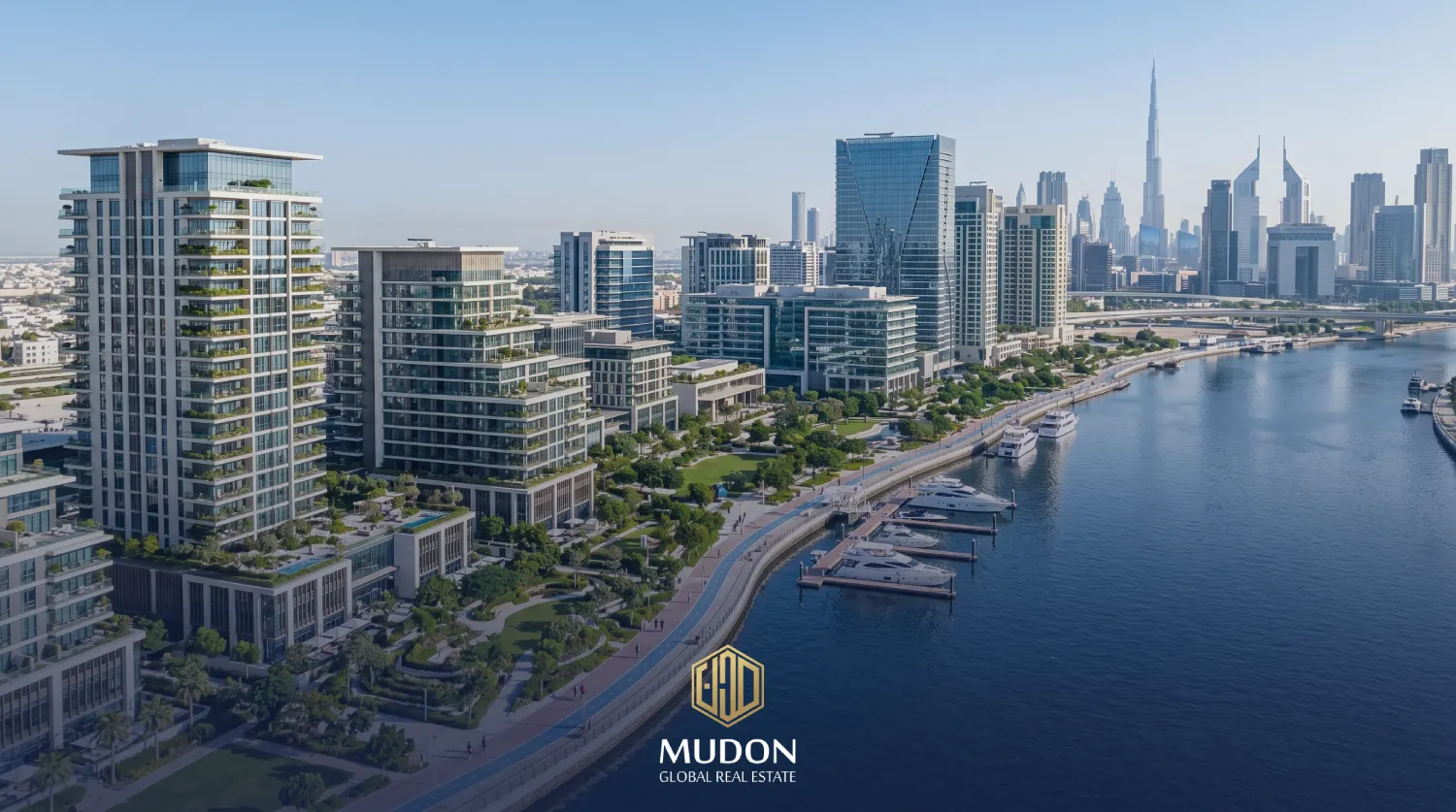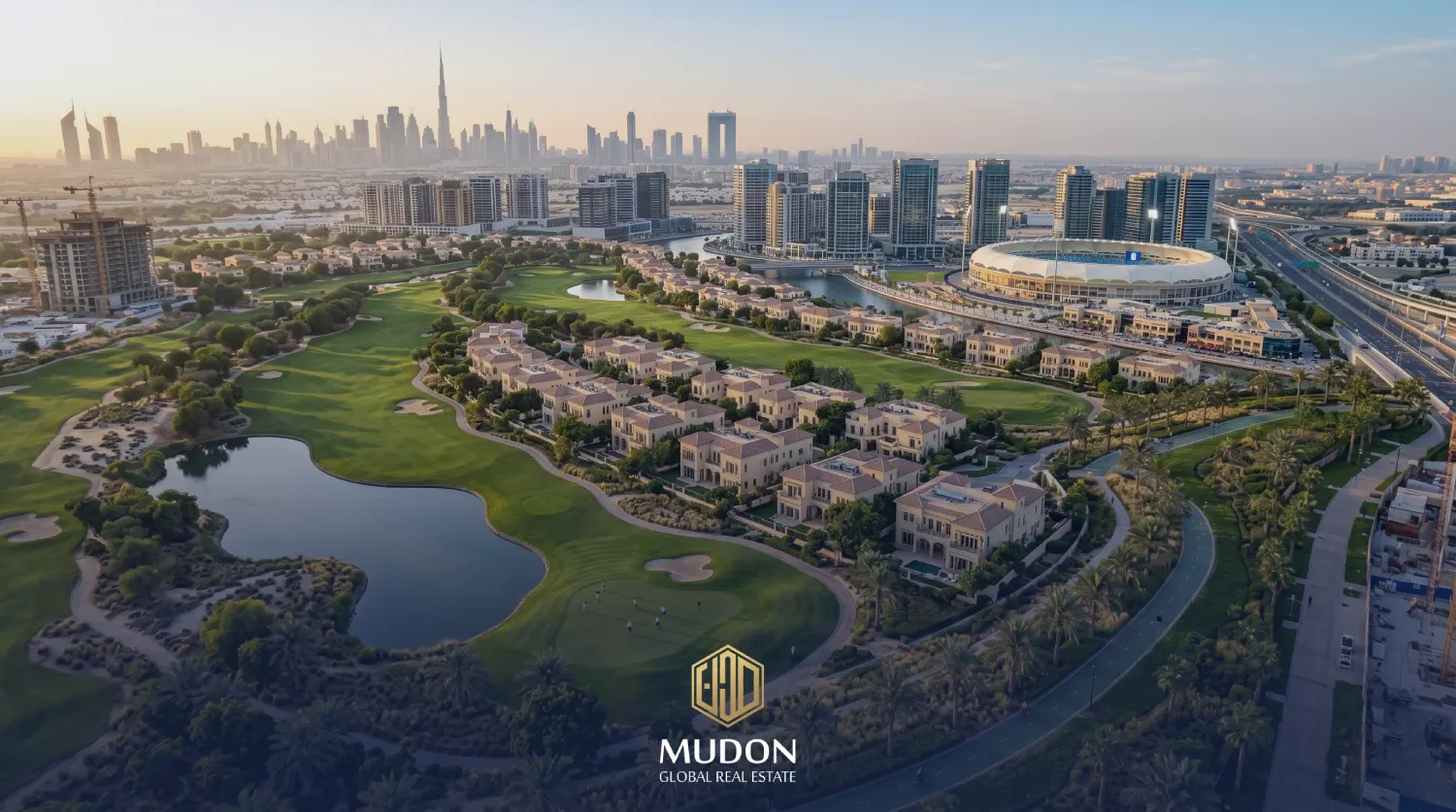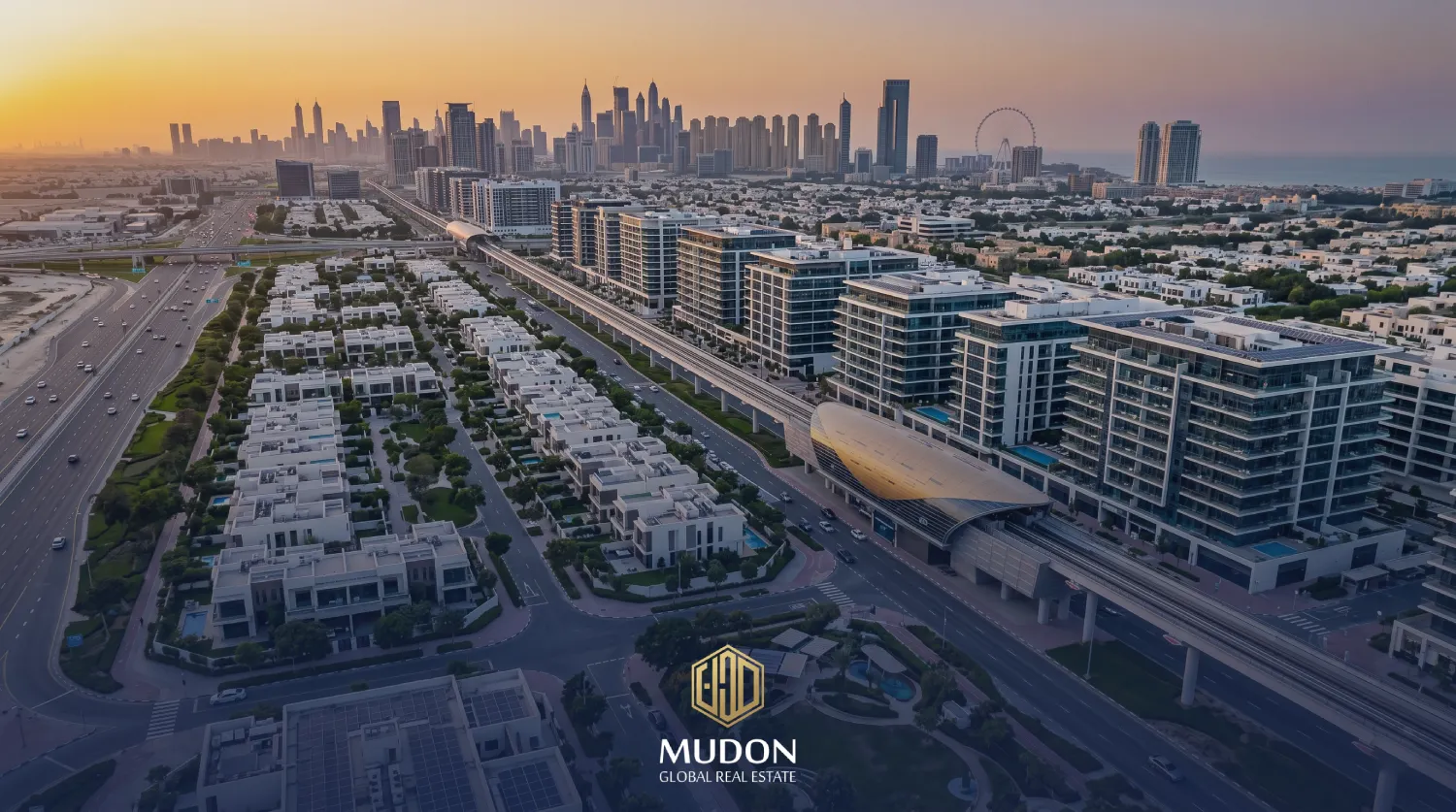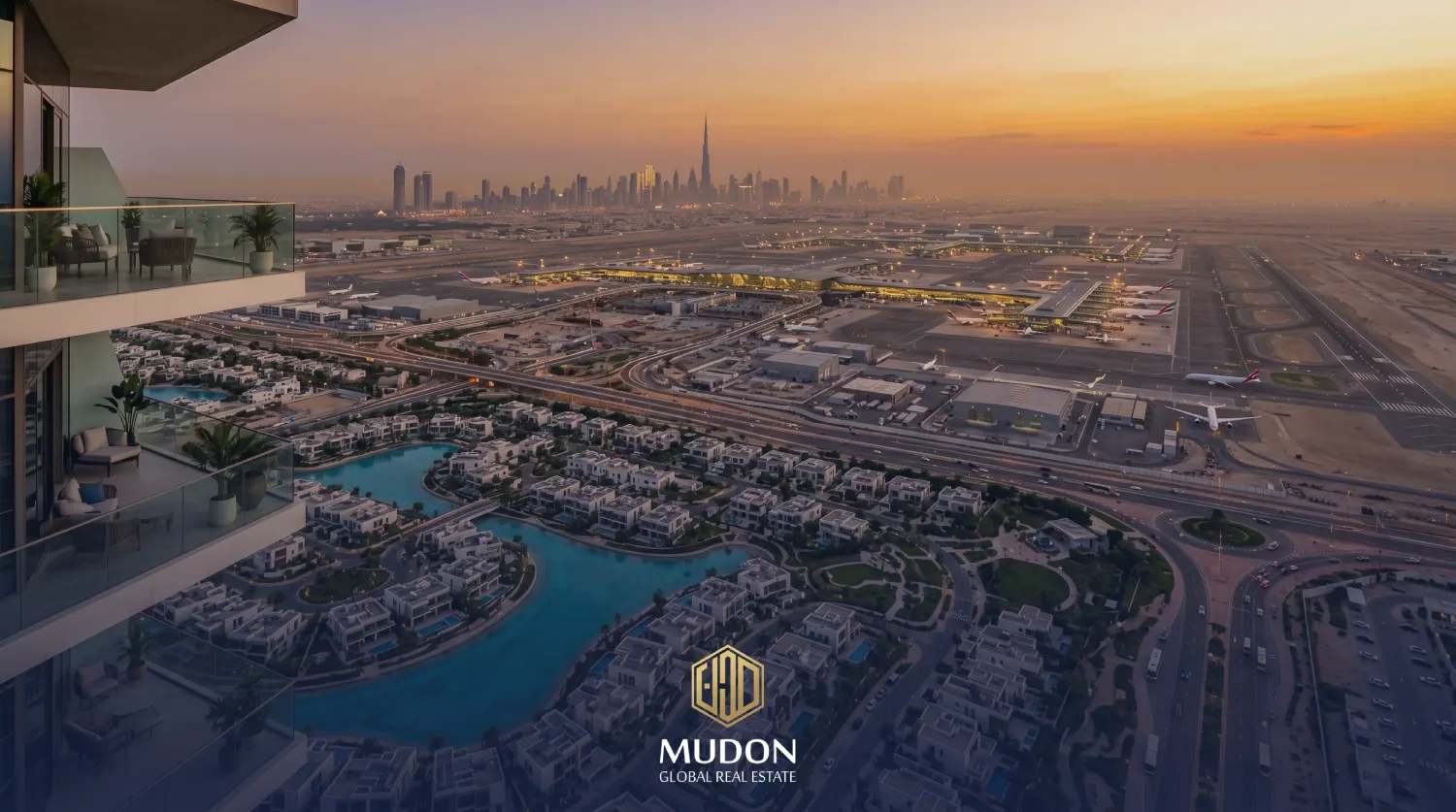
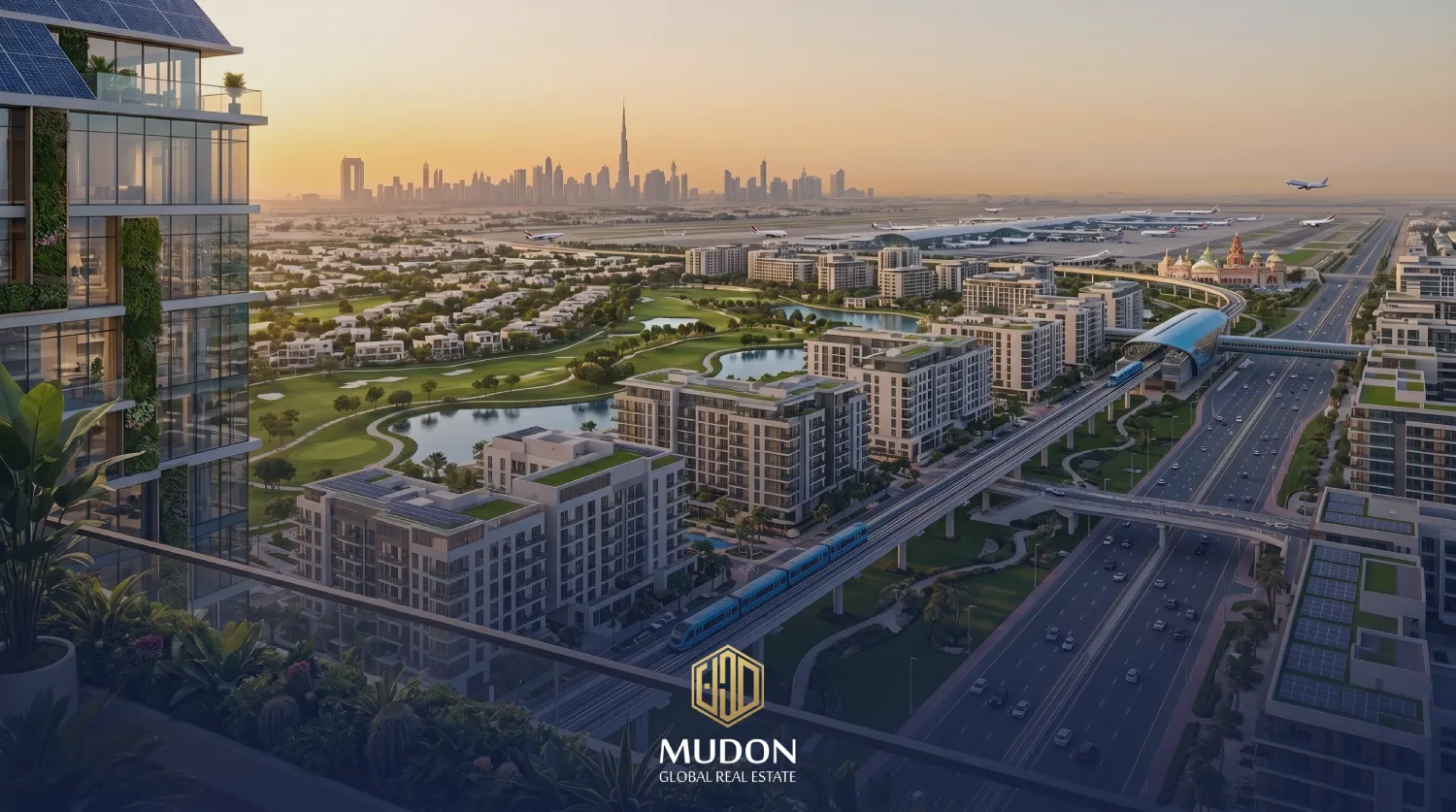
While major investors focus on iconic assets in Downtown or the waterfronts, analytical data for Dubai’s market in 2026 shows a strategic shift in institutional capital allocation toward “Dubai Land” (Dubailand).
This area is no longer classified as remote outskirts as in previous cycles, but has, thanks to rapid demographic growth (which has exceeded 4 million residents), become the “vital artery of the premium mid-market” and the primary engine absorbing residential demand from families and professionals.
As your wealth management advisors at Mudon Global, we present this analytical financial report that dissects the geography of “Dubai Land” in 2026, and explains how Family Offices and savvy investors can exploit valuation arbitrage gaps to build portfolios that balance secure capital appreciation with robust cash flows.
Table of Contents
Geographical and Economic Identity: What is “Dubai Land” from the perspective of institutional capital?
For the international investor unfamiliar with Dubai’s urban topography, the name “Dubailand” may seem misleading; it does not refer to a single residential compound, nor to an amusement theme park as originally envisioned in the early 2000s.
From the 2026 institutional capital perspective, Dubailand is classified as “the emirate’s largest integrated urban land portfolio”, and the primary demographic absorption engine for the premium middle class.
To understand this area financially and geographically before allocating liquidity, it must be viewed through three structural lenses:
1. Actual Scale and Geographic Depth (Macro-Scale)
Dubailand spans a vast area exceeding 278 square kilometres (nearly 3 billion square feet). To visualize this scale, it is larger than Downtown Dubai, the Marina, and Palm Jumeirah combined by dozens of times.
Geographically, the area sits behind the densely populated coastal belt and is strategically positioned between two of the emirate’s most important logistical arteries: Sheikh Mohammed Bin Zayed Road (E311) and Emirates Road (E611). This positioning gives it exceptional access to all of Dubai’s economic nodes without passing through downtown congestion.
2. Maturity and Structural Pivot (The Structural Pivot)
Historically, Dubailand was launched as an ambitious tourism and entertainment destination, but the smartest economic shift came when Dubai’s government and leading developers repositioned it as “the emirate’s new residential heart”.
Today in 2026, the vast land areas have matured into fully inhabited communities, home to hundreds of thousands of residents, supported by advanced infrastructure including modern road networks, hospitals, and dozens of international schools serving expatriate families.
3. Financial Structure: A Conglomerate of “Micro-Cities” (Conglomerate of Micro-Cities)
From an investment perspective, Dubailand should not be viewed as a single asset, but as a “natural multi-asset real estate investment trust (REIT)”. It is a major geographic umbrella beneath which sit dozens of self-sufficient “micro-cities” (Master-Planned Communities), developed by the giants of the real estate market. These assets are internally divided into:
- Green horizontal communities: such as Emaar’s The Valley and DAMAC’s communities (DAMAC Hills), geared toward families and capital growth.
- Integrated vertical communities: such as the Dubai Land Residential Complex (DLRC) and Majan, geared toward students, professionals, and rapid cash flow generation.
- Integrated leisure and sports destinations: such as Global Village, Dubai Sports City, and polo communities, which ensure sustained footfall and support the short-term rental economy.
Value Drivers in Dubailand 2026: The Airport Corridor Effect and Real Estate Governance Regulation
“Dubailand” derives its investment resilience in the 2026 financial cycle from a dual economic moat, anchored in Dubai’s largest logistical infrastructure transformation and reinforced by the highest standards of regulatory governance and transparency.
The area is no longer merely a zone for horizontal expansion; it has become the strategic hub for absorbing capital and human flows moving toward the south of the emirate.
Here is the financial and operational breakdown of these two drivers:
1. The Airport Corridor Effect: Repositioning the Economic Geography
The launch of massive construction packages for the expansion of Al Maktoum International Airport (DWC) at a cost of AED 128 billion ($35 billion), across an area of 70 square kilometres, has not only transformed aviation, but completely redrawn Dubai’s real estate demand map.
As the closest residential flank to this megaproject, Dubailand benefits from this shift through several strategic channels:
Direct Arterial Connectivity
Dubailand is directly and decentrally connected to the parallel highway network, specifically Emirates Road (E611) and Sheikh Mohammed Bin Zayed Road (E311).
This positioning makes it the fastest residential gateway to the airport’s new campus, bypassing coastal-area traffic bottlenecks.
Absorbing Executive Human Capital
As construction and operational works on the new terminals (West Terminal and the first concourse) advance to more mature stages in 2026, the market is seeing a steady migration of senior executive talent in aviation, engineering, and logistics toward the south.
This segment is looking for master-planned communities that provide family-oriented living quality and green spaces, making villa and townhouse communities in Dubailand the first choice for long-term corporate leases.
Hedging Against Central Price Inflation
Investors understand that prices in the immediate airport zone (Dubai South) are experiencing rapid speculative inflation. By contrast, Dubailand offers the investor a valuation arbitrage advantage; it provides mature, ready-to-operate assets at competitive entry prices, while fully capturing the positive impact of airport-corridor growth.
2. Implementation of the Dubai Land Department (DLD Strategic Plan 2026): Institutional Immunity
Massive international capital cannot enter a particular area without solid regulatory guarantees. Dubailand enters 2026 benefiting from the completion and implementation of the five pillars of the “DLD Strategic Plan 2026”, which has moved the market from simple sales facilitation to building a “global data- and governance-based real estate model”.
This regulatory umbrella is reflected in your Dubailand assets through the following mechanisms:
Data-Driven Sector
Thanks to the integration of DLD’s digital infrastructure, family offices and international investors can access live transaction data, precise price-per-square-foot indicators, and historical yield rates for every sub-community in Dubailand.
This level of transparency eliminates price distortion and enables the construction of accurate financial models for forecasting returns.
Digital Escrow Governance
The 2026 initiatives focused on automating and protecting escrow accounts for off-plan projects. This development gave conservative European and Asian capital complete confidence to direct liquidity into the new projects launched in Dubailand, fully aware that payments are strictly tied to actual construction progress on the ground.
Innovation Incubators and Exit Facilitation (Proptech & Liquidity)
The department’s adoption of proptech solutions and the facilitation of instant ownership transfers (Exceptional Journeys 2.0) have increased liquidity in the secondary market.
An investor who establishes a financial position today in Dubailand apartments or villas has exceptional flexibility in executing exit strategies and liquidating assets globally with a few clicks and minimal paperwork and bureaucratic friction.
Infrastructure and Transportation: Removing Logistics Bottlenecks and Capturing the “Metro Leap”
Institutional real estate valuations in Dubai move not only based on construction quality, but are closely tied to “logistics flow efficiency” and travel time to central economic nodes.
Dubailand is entering a new pricing maturity phase driven by the removal of its biggest historical bottleneck, in parallel with its connection to the future rail network:
1. Removing Logistics Bottlenecks: The Financial Impact of the “Hessa Street Upgrade”
The biggest psychological and operational barrier facing tenants in Dubailand communities was the severe traffic congestion during peak hours. That equation has changed dramatically with the Roads and Transport Authority (RTA) opening the first phase of the Hessa Street upgrade, and accelerating work on phase two (with a total project cost of approximately AED 690 million).
Project Logistics Engineering
The ongoing works extend along the strategic corridor linking Al Khail Road and Sheikh Mohammed Bin Zayed Road (E311), and include widening the street to four lanes in each direction, doubling its capacity by 100% to reach 16,000 vehicles per hour.
The construction package includes elevated bridges spanning 8,835 metres and a strategic 480-metre tunnel, directly serving more than 650,000 residents across 10 residential areas.
The Financial Impact (The Premium Reset)
This radical development cuts travel time from Dubailand to the heart of Dubai’s commercial centre (Sheikh Zayed Road and the Marina) from 24 minutes to just 5 minutes (a reduction of nearly 80%).
In financial analysis, removing the “congestion barrier” immediately raises the area’s appeal to executive tenants, pushing rents and asset values up by an anticipatory 10% to 15%, transforming the area’s historical pricing discount into capital gains for the owner’s portfolio.
2. Public Transport Revolution: Financial Positioning to Capture the “Metro Leap” (Metro Effect)
While Blue Line excavation works are drawing attention in Dubai Creek, the new strategic expansions of the Dubai Metro network place Dubailand at the core of the next growth phase, specifically as public transport routes reach the academic and residential belt.
Strategic Connectivity (The Academic & Silicon Hubs)
The expansion routes cut through Dubailand’s vital arteries; the new stations serve high-density communities, ending at the terminal station in “Academic City” via Dubai Silicon Oasis.
This link integrates communities such as DLRC and Majan directly into the automated rail network that carries hundreds of thousands of passengers daily.
Capital Hedging and Catching the Leap
The savvy investor who establishes a financial position today in Dubailand’s vertical communities is not only buying on the basis of current high rental yields (7% – 10%), but is also pursuing a strategy of “proactive hedging”.
Historically in Dubai’s market, properties within a 500-metre radius of new stations experience a capital jump of 15% to 20% once station locations are confirmed and actual operations begin. Positioning today ensures this compounded capital growth is captured before the market closes the valuation gap.
Micro-Geography: Financial Distribution of Dubailand Communities and Liquidity Allocation
Given the vast geographic extent of Dubailand, treating it as a single investment block is a strategic mistake. To achieve high allocation efficiency, the area must be broken into two distinct financial sectors; each sector has its own “profit code” and an independent operating structure targeting a specific market segment.
Here is the detailed financial and operational analysis of these two sectors:
1. Integrated Family Communities (Master-Planned Communities): Defensive Hedging and Capital Growth
This sector forms the backbone of demographic stability in Dubailand, led by major developers through vast horizontal projects such as Emaar’s The Valley, DAMAC’s communities (DAMAC Hills and DAMAC Lagoons), and Dubai Properties’ communities (Villanova).
Asset Engineering and Amenity Integration (15-Minute Cities)
The development philosophy here is based on creating “self-sufficient economies.” The client is not merely buying a villa or townhouse, but acquiring a stake in an integrated environment featuring swimmable artificial lakes, world-class golf courses, embedded international schools, and healthcare facilities.
This urban design creates a psychological and practical barrier that prevents residents from leaving the community for their daily needs.
Demand Profile (End-User Dominance)
The primary demand driver here is the “end user” (resident families and executives).
This segment seeks spaciousness, privacy, and environmental safety for children, and is willing to pay a “stability premium” in exchange for long-term lease contracts.
Financial Behavior and Return Engineering
This sector is classified as a “defensive wealth-preservation asset”. Thanks to the family-oriented tenant profile, these communities record vacancy rates close to zero, with a significant reduction in asset wear and tear costs.
From a capital perspective, these units in 2026 achieve compound capital growth of 4% to 8% annually, supported by the scarcity of land designated for ready villas and the flow of family liquidity toward ownership rather than renting.
2. Mid-Rise Residential Towers Sector (DLRC & Majan): Maximizing Returns and Cash Flows
In contrast to the calm of horizontal communities, the vertical belt in Dubailand—specifically the Dubai Land Residential Complex (DLRC) and the Majan district—represents a high-density, high-activity engine designed to generate liquid cash flow.
Architectural Efficiency and Integrated Assets
The development philosophy here relies on mid-rise buildings focused on maximizing the use of every square metre. Studio units and one-bedroom apartments (1BHK) dominate, equipped with smart-home systems, durable practical finishes, and shared amenities (co-working spaces and co-living amenities) suited to a fast-paced lifestyle.
The Demographic Driver (The Academic & Professional Magnet)
This sector derives its operational momentum from its direct location on the edge of “Academic City” and Dubai Silicon Oasis.
This positioning makes it the mandatory residential haven for thousands of international students, academic staff, and young professionals working in technology and startup sectors, who are seeking modern, affordable housing close to their places of work and study.
Financial Behavior (Cash Flow Optimization)
This sector is classified as a “cash flow machine” in your real estate portfolio. Thanks to lower entry prices compared with Downtown and dense, ongoing rental demand, this sector generates the highest net yields in Dubai, ranging between 7% and 10%.
These assets are excellent for an investor seeking high monthly or annual liquidity to reinvest, or to efficiently service mortgage obligations without relying on fluctuations in sale prices.
Commercial and Leisure Maturity: Turning Global Village and Retail Centers into Permanent Economic Engines
Historically, the major entertainment hubs in Dubailand—led by Global Village—were seen as seasonal assets active only during winter months and dormant in summer.
In the 2026 economic cycle, this sector is undergoing a structural transformation that moves it from mere “seasonal entertainment” to “year-round commercial and tourism infrastructure”, creating a direct effect on the pricing of surrounding residential assets.
This operational maturity is reflected in your real estate portfolio through the following mechanisms:
1. Operational Transformation and Retail Ecosystem Integration
Current development strategies are moving toward integrating entertainment destinations with modern retail and enclosed shopping centers. 2026 is witnessing the opening and expansion of major commercial complexes within the residential communities themselves (such as the massive expansions at “DAMAC Mall” and the retail centers in “Emaar Valley”).
Economic Impact: This integration turns Dubailand into a permanent commercial magnet that is not dependent on the weather. Providing retail and luxury dining options minutes from home raises the Livability Index, which allows owners to impose sustainable increases in annual lease values.
2. Monetizing Footfall and Feeding Short-Term Rentals (Footfall Monetization & Holiday Homes)
Entertainment and sports destinations in Dubailand (Global Village, IMG, and polo communities) attract millions of visitors annually. With surrounding infrastructure being developed to extend event stay durations, this enormous high footfall turns into direct fuel for the operation of the short-term rental economy (Airbnb / Holiday Homes).
Asset Repositioning: The investor who owns apartments in surrounding communities (such as DLRC or Majan) is no longer limited to students or professionals on fixed annual leases; they can now reposition their assets as “mini-hotel units”.
Targeting tourists and Gulf families visiting entertainment events enables dynamic pricing strategies, where daily rental rates rise during seasons and festivals to generate net rental yields exceeding 10% to 12%, accelerating the capital recovery cycle.
Financial Allocation Table for the Investor (Dubailand 2026)
| Financial Indicator | Family Communities (Master-Planned) | Mid-Rise Tower Sector (DLRC & Majan) |
|---|---|---|
| Asset Class | Villas and Townhouses (Horizontal) | Studios and Compact Apartments (Vertical) |
| Financial Objective | Wealth Preservation and Capital Growth | Maximizing Cash Flow |
| Tenant Profile | Families and executives | International students and young professionals |
| Tenant Turnover | Very low (stable 2-5 year leases) | Moderate to high (renewed annual contracts) |
| Expected Net Yield | 5% – 6.5% | 7% – 10% |
| Optimal Leverage | Buy & Hold for the long term | Buy for intensive operation (Yield Farming) |
Financial Analysis of Dubailand 2026: Return Engineering, Entry Prices, and Price Maturity Indicators
In institutional real estate portfolio management, asset efficiency is measured by its ability to generate the maximum possible cash flow per dirham invested (Capital Efficiency), while maintaining a safety margin that protects against economic-cycle volatility.
The analytical reading of the Dubailand market in mid-2026 shows that it is the best arena for applying a “cost-effective diversification” strategy.
Here is the precise financial breakdown of the area’s performance, expressed in the language of numbers sought by family offices and hedge funds:
1. Entry Prices (Entry Points): Capital Allocation Efficiency and Position Building
Dubailand is characterized by a deliberately low and well-calibrated entry barrier, giving investors exceptional flexibility in portfolio construction without resorting to excessive leverage.
Current pricing structure: The average prices of compact apartments (studios and one-bedroom 1BHK units) in vertical communities for 2026 range between AED 500,000 and AED 1,000,000.
Bulk Units Allocation: This low barrier changes the game for the institutional investor. Instead of freezing AED 4 million in a single luxury apartment in Downtown subject to a full vacancy risk (100% vacancy risk if the tenant leaves), the investor can allocate the same amount to acquire a package of 5 to 6 residential units in Dubailand.
Risk Mitigation: This surgical diversification ensures ongoing cash flow; even if one unit becomes vacant, the other units continue to operate efficiently and generate income, delivering solid financial stability for the portfolio.
2. Net Rental Yields (Rental Yields): Capturing Alpha and Cash Flow
Dubailand outperforms decisively on the metric of net return on investment, surpassing the emirate-wide averages thanks to the precise balance between purchase price and rising rental cost.
Solid regional benchmark: The overall average rental yields in Dubailand communities record between 6% and 8% net annually, clearly outperforming coastal and central areas where high purchase prices compress yields to 4.5% to 5.5%.
Generating Alpha (10%+): The real opportunity lies in the academic belt communities (such as DLRC and Majan). By acquiring intelligently designed units (micro-apartments) and outsourcing management to professional operators targeting flexible rental periods for international students and professors, net yields can climb to the 10% annual threshold.
This level of high cash flow enables the investor to recover the full capital in just one decade, while retaining ownership of the asset.
3. Market Stability Indicator (Market Reset): Flushing Out Speculators and Capital Maturity
The most reassuring financial signal for investors in 2026 is the corrective behavior recently seen in this sector, which moved it from a phase of “frenzied growth” to a phase of “institutional stability”.
The Healthy Correction (The 2025/2026 Market Reset): Late 2025 and early 2026 witnessed a strategic calming and stabilization in the pace of price inflation. This minor correction was not a negative signal; it was a necessary “natural filtering” of the market.
Flushing Out Speculators: This stage drove out short-term speculators (flippers) seeking quick paper profits, and established a solid price floor supported by actual transactions from end users and yield-seeking investors.
“Patient Capital” Haven: This pricing maturity has made Dubailand the preferred destination for long-term capital owners (family offices and pension funds). The market is now protected from price bubbles, and valuations move according to real supply-and-demand fundamentals and infrastructure growth, providing a safe and sustainable investment environment.
ESG compliance and smart infrastructure: reducing operating expenses and attracting institutional demand
In the 2026 investment landscape, implementing environmental, social, and governance (ESG) standards is no longer an architectural luxury, but a key determinant of real estate asset valuation and international liquidity flows.
The new projects launched in Dubailand stand out because they are designed from the outset to accommodate these strict regulatory requirements, positioning investors’ assets to attract green investment funds and institutional portfolios.
Here is the financial and operational breakdown of how this smart infrastructure turns into direct profits in your portfolio:
1. Environmental Tech: Advanced Thermal Engineering and Net Yield Protection
Developers in Dubailand focus on integrating proactive building technologies aimed at reducing energy consumption, which directly lowers operating expenses (OPEX) and annual service charges borne by the owner:
Self-regulating efficient cooling systems: reliance on the new generation of district cooling systems integrated with smart thermal sensors, which consume 20% to 30% less energy than conventional air-conditioning systems.
Advanced Thermal Insulation: the use of double-glazed façade materials and structural insulation that prevent external heat infiltration, reducing the operating burden on cooling systems during summer months and preserving the building’s sustainability.
AI-Driven Lighting: automating shared spaces and corridors with lighting systems that adapt to resident movement and natural light levels, eliminating electricity waste entirely.
Financial impact for the investor: Lower utility bills and maintenance costs protect net rental yield margins from erosion and make the property more attractive to tenants seeking a lower total cost of living.
2. Social Dimension: Quality of Life as a Lever for Asset Valuation
The social aspect of ESG focuses on the concept of “wellness living”, a crucial factor in raising the property’s social rating and increasing its capital value:
Interactive spaces and hanging gardens: dedicating integrated rooftop gardens and shaded relaxation areas, reducing the effect of urban heat islands and giving residents a natural outlet within the residential towers.
Green, pedestrian-friendly pathways: linking communities with dedicated running and cycling tracks threaded through vast green spaces, encouraging non-motorized transport and enhancing the community’s overall health.
Capturing corporate demand: This level of environmental and social compliance opens a strategic door to high-value rental demand. Global multinational companies (MNCs) relocating their headquarters near Al Maktoum International Airport are often required by internal policy to lease accommodation for their employees and executives exclusively in ESG-compliant buildings.
This ensures the owner signs long-term corporate lease contracts, at rates above normal market levels, with near-zero tenant churn.
3. Governance and Financing Appeal (Green Financing & Liquidity)
Smart infrastructure in Dubailand is reflected on the investor’s financial side when dealing with the banking sector. Properties classified as “green assets” allow buyers to benefit from “green mortgages” offered by Dubai banks in 2026, featuring reduced interest rates and more flexible repayment periods.
Full compliance with sustainability standards also gives the real estate asset high exit liquidity, as international real estate investment trusts (REITs) are aggressively seeking to acquire portfolios of these regulated assets to strengthen their sustainable balance sheets.
Start Your Investment Journey: Contact Mudon Global Experts
Securing strategic high-yield assets in “Dubailand” requires measured action and precise financial guidance. Whether you are seeking off-plan units to capture capital growth, or acquiring ready assets to generate immediate cash flow, the advisory and wealth management team at Mudon Global is ready to provide full executive support.