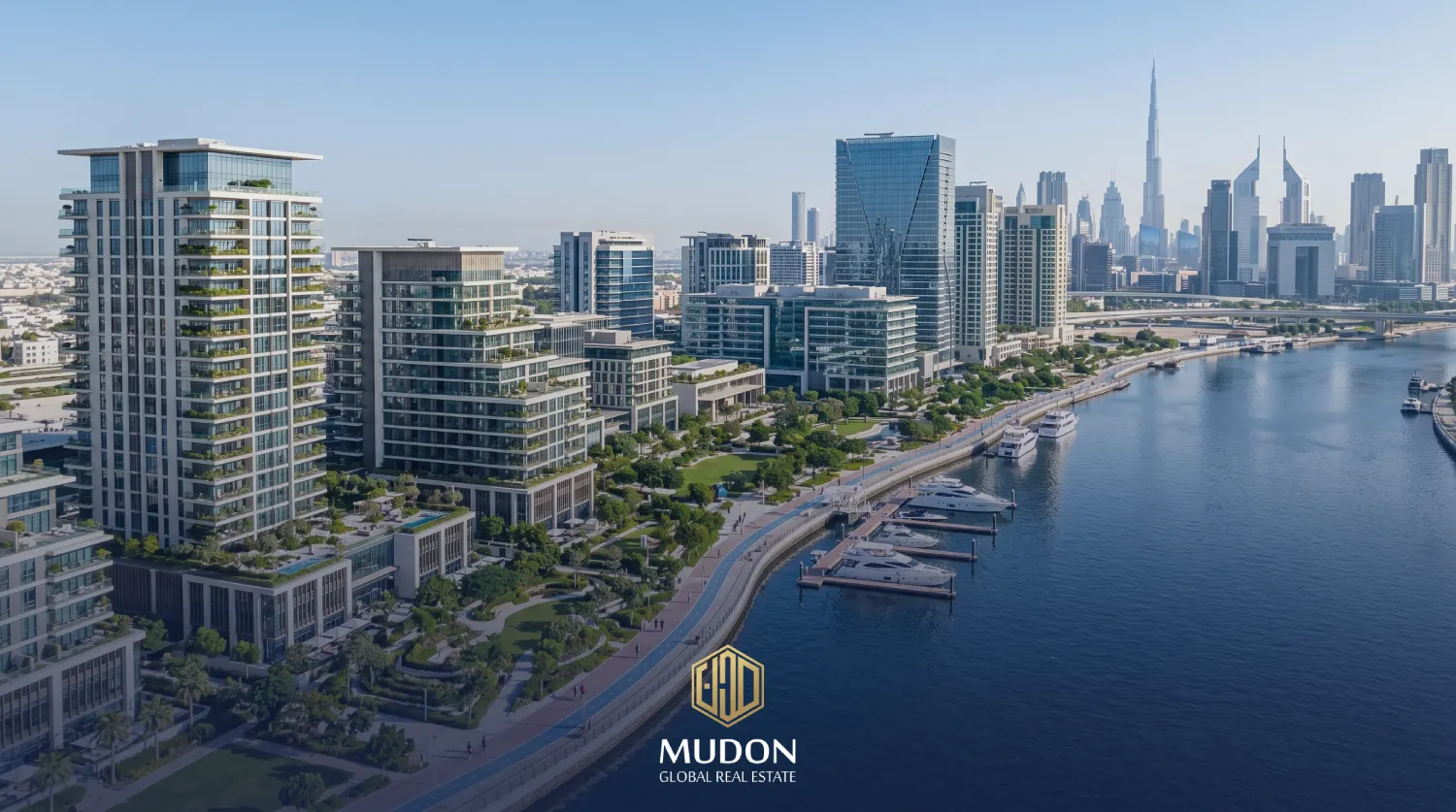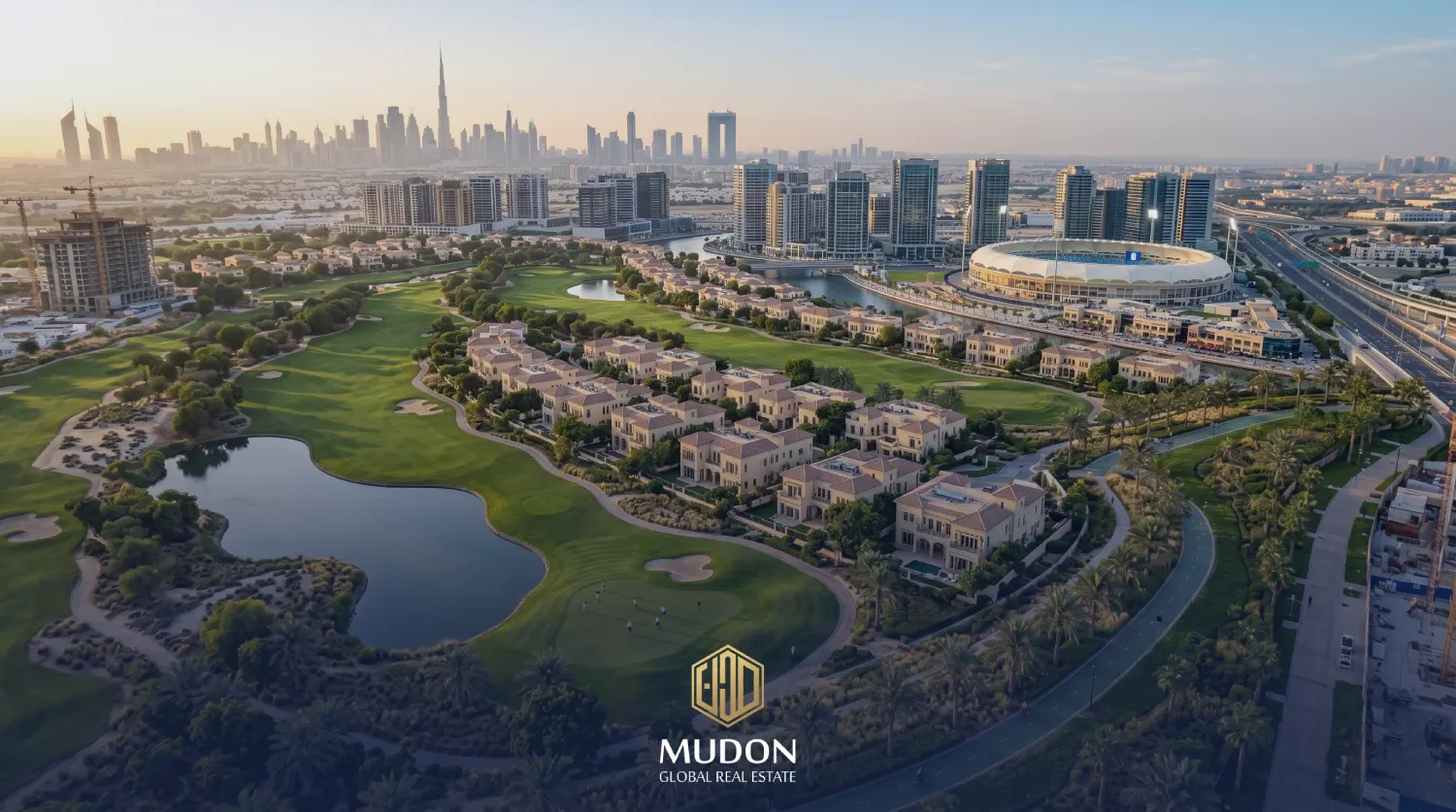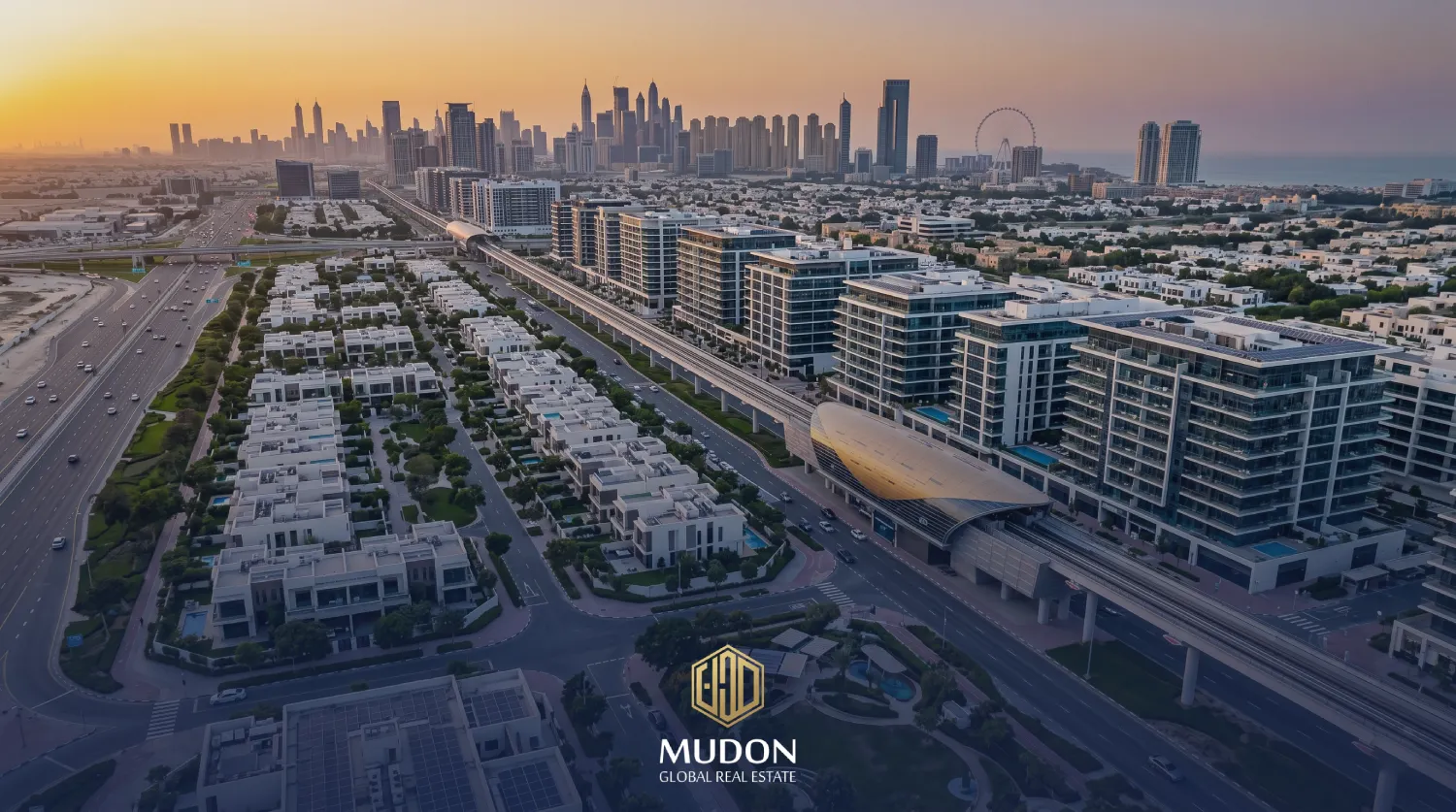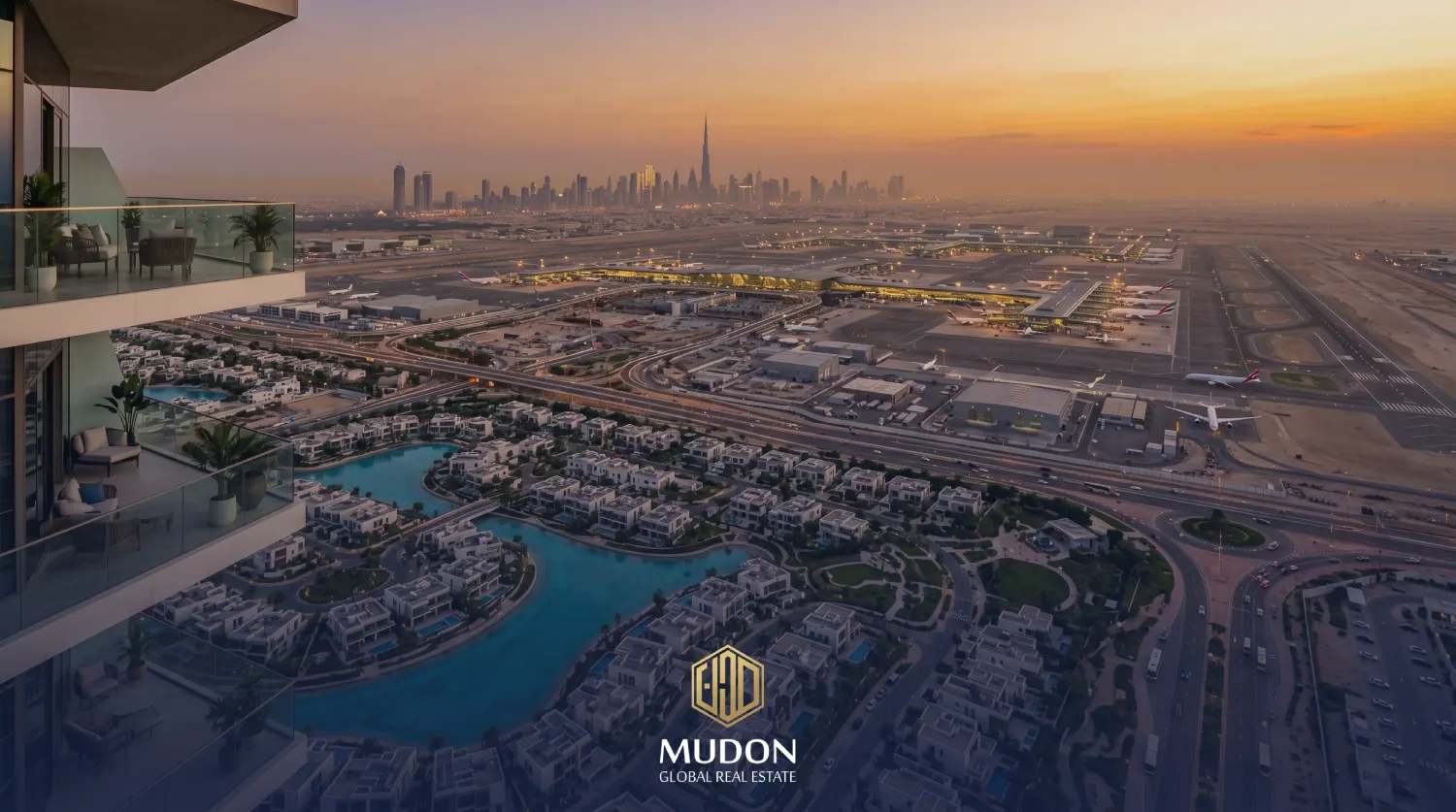
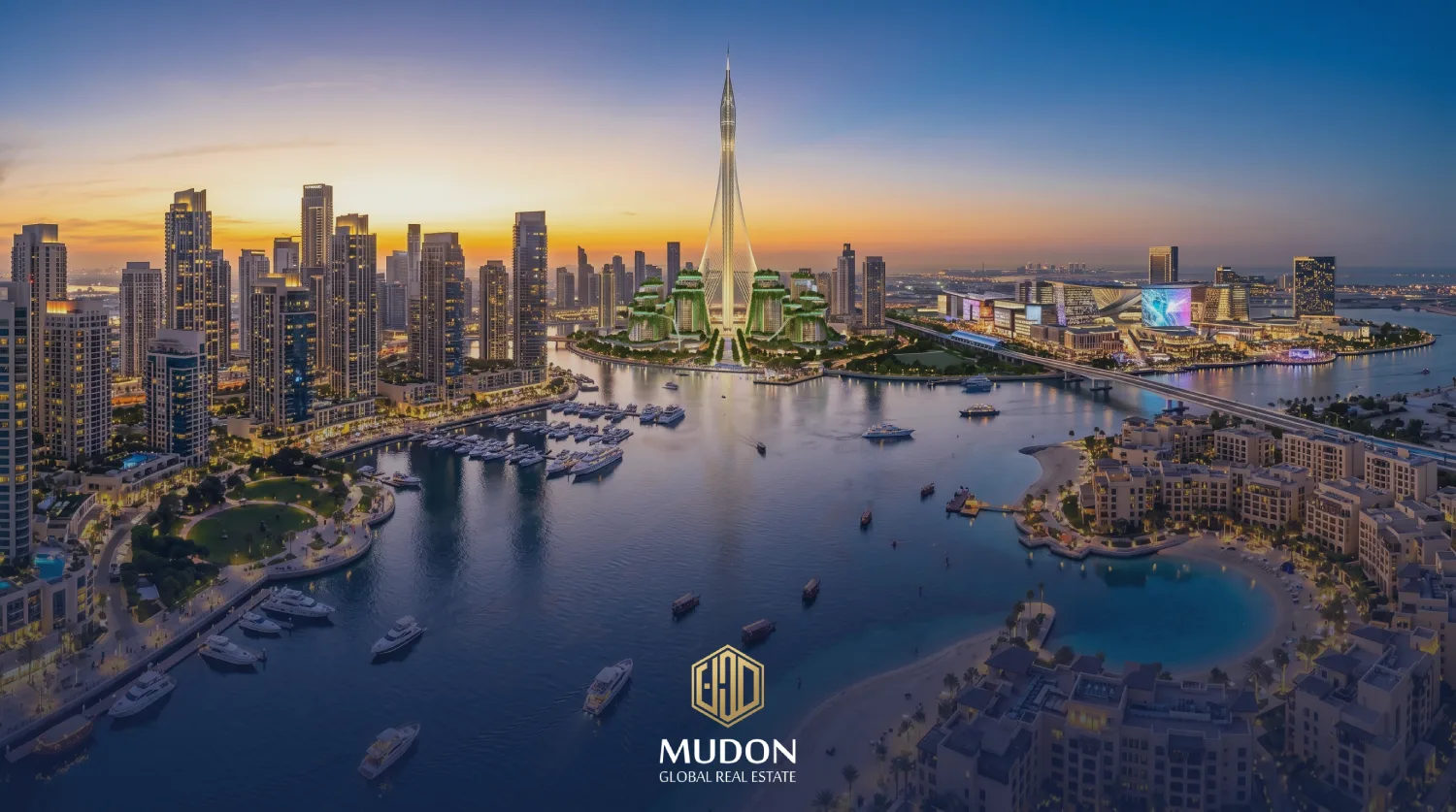
While “Downtown Dubai” represents the mature financial and commercial core, major investors and family offices view “Dubai Creek Harbour” in 2026 as “Downtown 2.0”.
It is not merely a residential district, but a fully integrated megapolis spanning 6 square kilometers—twice the size of Dubai’s current city center—combining luxury waterfronts, environmental sustainability, and smart infrastructure.
As your advisors at Mudon Global, we believe that acquiring in Dubai Creek Harbour today represents a first-mover advantage strategy at the heart of Dubai’s new urban center, before valuations reach their eventual peak by 2030.
Table of Contents
Competitive Advantage: The Megaproject Economy and the Dual Engines
In the world of institutional investing, sustainable real estate valuations are not built on a mere “beautiful water view”; they are built on the presence of massive capital catalysts capable of reshaping a city’s economic geography.
The true capital value of Dubai Creek Harbour rests on what we at Mudon Global call the “dual engines.” These two engines are not merely buildings, but integrated economic systems that will reshape Dubai’s architectural and commercial profile by 2030:
Engine One: Dubai Square – The AI-Powered Retail Capital
We are not talking here about a conventional “shopping mall,” but about a revolution in retail space concepts, backed by an estimated development cost of AED 180 billion. “Dubai Square” is designed to be the first mini-city integrating the physical and digital worlds (Omnichannel Retail) in the Middle East.
Technology infrastructure: The project will rely on AI technologies to analyze consumer behavior, deliver immersive tech experiences, and provide vast spaces for luxury brands to create “interactive stores.”
Real estate impact (institutional demand): This enormous scale of technology and business will create thousands of jobs in the senior management of retail and technology sectors. These executives will seek luxury residences just steps from their offices in “The Island District,” creating resilient institutional demand that supports stable long-term annual leases.
Real estate impact (tourism demand): As a global leisure destination, “Dubai Square” will attract millions of visitors annually. This massive footfall is the primary fuel that will power the apartments at “Creek Beach,” lifting average daily rates (ADR) and increasing holiday home yields to net levels exceeding 8%.
Engine Two: Dubai Creek Tower – The Strategic 2026 Vision
The transformation this tower underwent in early 2026 is the “best financial news” for investors. Following Emaar’s strategic reassessment and the tendering of a new design, the tower has moved away from the idea of a “height race” and embraced the philosophy of “sustainable luxury and urban iconography”.
Architectural transformation: The new focus is on high environmental efficiency, the creation of vast hanging gardens, and ultra-luxury panoramic observation decks that blend spectacle with an exclusive hospitality experience.
Creating the “View Premium”: In real estate valuation language, iconic landmarks act as “wealth magnets.” The tower’s evolution into an environmental visual masterpiece means that any apartment or penthouse with a direct line of sight to it will immediately command a pricing premium. Investors who acquire apartments today at AED 2,500 per square foot because of their future tower views will witness exceptional capital appreciation once the actual structure begins to rise.
Sovereign appeal: This emphasis on quality rather than abstract height attracts UHNWIs seeking trophy assets, transforming Dubai Creek Harbour from a mere “investment district” into a stronghold for legacy assets.
Economic Synergy
What makes these engines unstoppable is the structural linkage between them. Dubai Square and Dubai Creek Tower will not be isolated; they will be connected by the Dubai Metro Blue Line and fully air-conditioned pedestrian routes.
This creates an integrated micro-economy, where residents live, work, shop, and relax within 6 square kilometers without needing to leave the district.
This economic moat is what protects your capital from broader market volatility and secures compounded capital growth for 2026 and beyond.
Dubai Creek Harbour’s Real Estate Segmentation: How to Choose Between “The Island District” Luxury and “Creek Beach” Liquidity
The real estate valuation within Dubai Creek Harbour in 2026 does not follow a one-size-fits-all rule. We are looking at two cities within one city; each serves a distinct financial objective.
To allocate your capital precisely, these two communities must be broken down by their investment mechanics:
1. The Island District: Dubai’s Manhattan and Vertical Monopoly
If your objective is wealth preservation and capital appreciation, then “The Island” is your operating theater. This district is designed as a high-density urban core, where luxury towers rise around a large marina and a green central park.
The View Premium pricing mechanism: Value here is not measured solely by the apartment’s size, but by what it sees from the windows. Apartments with unobstructed views of the “Downtown Dubai” skyline and the “Ras Al Khor” Wildlife Sanctuary enjoy the characteristics of “monopoly assets.”
This means its price rises independently of broader market conditions, simply because nothing can be built in front of it in the future to block that view.
Demand profile (The Avatar): The tenant and end buyer here is the “executive” or “international investor” working in the DIFC and seeking tower luxury, proximity to yachts, and fast access to the airport.
The asset’s financial behavior: Properties here command long-term annual leases (cash-flow stability) and enjoy exceptionally high liquidity in the secondary market when you decide to resell and realize gains.
2. Creek Beach: The Urban Riviera and the Cash-Flow Machine
If your investment objective is high monthly income generation and rapid capital recovery (ROI), then “Creek Beach” offers a currently unmatched economic model in Dubai. This district has moved beyond the tower concept to deliver low- to mid-rise luxury and resort-style living in the heart of the city.
The holiday home economy: Thanks to the 700-meter artificial sandy beach and the shaded streets reserved exclusively for pedestrians, this district has become the leading destination for short-term rentals/Airbnb. Foreign visitors and GCC families prefer renting an apartment here to experience a resort lifestyle rather than a conventional hotel stay.
Demand profile (The Avatar): Families, tourists, and those seeking tranquility away from elevator congestion and complex parking arrangements. The design here echoes modern European coastal towns.
The asset’s financial behavior: Net returns here outperform The Island District. With daily or weekly rental models and dynamic seasonal pricing, a two-bedroom apartment in “Creek Beach” can generate an annual return reaching 8% or 9% net, making it an excellent instrument for funding other investment portfolios.
Guidance Summary for Mudon Global Investors
Choosing between “The Island” and “The Beach” is like choosing between growth stocks and dividend stocks in the equity market:
- Choose The Island District if you are seeking a trophy asset to pass on as a legacy, and you are betting on a significant increase in property values with the completion of the architectural icons in 2026 and beyond.
- Choose Creek Beach if you want to put your capital to work intensively to generate high, recurring cash flow driven by Dubai’s rising tourism activity.
The Language of Numbers: Dubai Creek Harbour’s Financial Performance in 2026 and the Strategic Arbitrage Opportunity
In luxury real estate markets, true wealth is created by identifying price gaps before the market closes them. Dubai Creek Harbour today represents Dubai’s largest valuation arbitrage opportunity, offering urban infrastructure and assets that are structurally superior to Downtown Dubai, yet at a pricing discount that clearly signals capital growth potential.
Here is the precise financial breakdown of the district’s performance:
1. Entry Points and Capital Positioning
Investment entry in Dubai Creek Harbour remains at highly absorbable levels, enabling investors to diversify their portfolio across multiple units rather than locking capital into a single asset:
Apartments segment (1BHK & 2BHK): One-bedroom units in the latest 2026 projects (such as Emaar Albero and Creek Haven) start from AED 1.8 million. This pricing represents an ideal entry point for investors seeking fast liquidity and strong rental yields, given the significant demand from young professionals and newly appointed executives.
Family and townhouse segment: Larger three-bedroom units and ground-oriented townhouses in Creek Beach start from AED 3.5 million to AED 4.5 million. This category directly targets established families, ensuring the owner long-term leases and reducing vacancy rates to a minimum.
2. PSF Pricing Index and the Capital Growth Gap
Here the essence of the investment opportunity becomes clear. The average price per square foot in Dubai Creek Harbour during 2026 ranges between AED 2,100 and AED 2,600 (varying upward or downward based on direct water views or the Ras Al Khor Sanctuary).
Upside potential calculation: When comparing this metric with Downtown Dubai (where prices start at AED 3,200 per square foot and exceed AED 4,500 for luxury units), we recognize that Dubai Creek Harbour trades at a discount of between 30% and 40%.
As infrastructure delivery continues and the key landmarks are completed, this pricing gap will inevitably close, meaning that the difference will translate directly into “unrealized equity” in the early buyer’s portfolio.
3. Net Rental Yield (Net ROI) and Operational Efficiency
The district’s distinction is not limited to price growth; it also extends to cash-flow generation. The area currently records solid investment returns ranging between 6.8% and 7.5% net.
Operational drivers: This elevated return is supported by strong occupancy rates exceeding 88% in completed towers. In addition, the relatively low service charges, enabled by sustainable infrastructure and the smart central cooling systems built by Emaar, protect net yield margins and prevent rental profit erosion.
4. The Next Engine (The Metro Effect) and Price Cycle Acceleration
Major transportation infrastructure developments are the fastest catalyst for property prices globally. Progress on the Dubai Metro Blue Line, which will pass directly through the district, provides enormous support for current prices.
Historical market rule: Historically in Dubai, properties within 500 meters of new metro stations see a pre-emptive capital jump of 15% to 20% once operations begin.
Buying in Dubai Creek Harbour in 2026 means positioning capital correctly to capture this assured price increase before the metro becomes fully operational in 2029, adding another layer of capital-growth gains for the investor.
Impact of ESG Sustainability Standards on Real Estate Valuation and Institutional Liquidity Attraction
In the 2026 global investment landscape, the term “sustainability” is no longer merely a marketing add-on to enhance a project’s image; it has become a decisive financial requirement governing the movement of large capital pools.
Family offices, international investment funds, and pension funds are now subject to strict global regulations that require them to allocate defined portions of their portfolios to real estate compliant with Environmental, Social, and Governance (ESG) standards.
From this regulatory perspective, Dubai Creek Harbour is more than a luxury residential destination; it is classified as a Green Asset, for the following structural reasons:
Low-Carbon Infrastructure Engineering and OPEX Reduction
The entire city has been planned as a model of urban efficiency. Reliance on AI-powered district cooling systems and the use of solar panels to operate public facilities dramatically reduce energy consumption.
For the investor, this means a direct and sustainable reduction in operating expenses (OPEX) and service charges, which translates immediately into higher net return margins (Net ROI) than comparable older conventional towers.
Environmental Integration with the Ras Al Khor Sanctuary (Biodiversity Protection)
Unlike projects that clear nature in favor of concrete, Dubai Creek Harbour has been designed to extend and protect the Ras Al Khor Wildlife Sanctuary, which is home to tens of thousands of migratory birds such as flamingos.
This strict environmental commitment gives the project a first-tier AAA social and environmental rating in international real estate valuation records.
Generating the Green Premium and Exit Power
What matters to you as an individual investor or an institutional representative is how this affects property pricing. ESG-compliant assets enjoy what financial markets call the Green Premium.
This means major financial institutions are willing to pay 10% to 15% more to acquire these properties in the future in bulk, in order to balance their environmental books. As a result, the early investor in Dubai Creek Harbour holds assets with high institutional liquidity, making the exit strategy and resale process very fast and highly profitable.
Positive Monopoly of the Master Developer: How Does Emaar Protect Your Asset’s Capital Value?
In open property markets, the presence of multiple developers within the same geographic area often creates a strategic risk, as construction quality varies, architectural styles conflict, and irrational price wars emerge that damage property values.
Here the strongest defensive advantage of Dubai Creek Harbour emerges: it is under full master-developer control and management by Emaar.
In institutional investment language, this is classified as positive monopoly, an economic moat that protects investor capital through three strict mechanisms:
1. Scarcity Engineering and Strict Supply Control
The biggest fear for any property investor is oversupply, which erodes prices. Thanks to its absolute control, Emaar applies a phased release strategy. New residential communities are launched only after a precise study of the market’s absorption capacity.
This direct control over the supply tap prevents market flooding and creates a state of directed artificial scarcity, ensuring that property prices for early investors on the secondary market continue to rise.
2. Architectural Harmony and Asset Standardization (Standardization of Luxury)
In Dubai Creek Harbour, you will not find an ultra-luxury tower next to a low-quality commercial building. Emaar imposes a strict design code across the entire 6 square kilometers. This standardization in finish quality, green-space distribution, and street planning ensures that every residential unit sits within an integrated premium ecosystem.
This visual and structural consistency lifts the overall macro-valuation of the entire district, which positively reflects on the price of each individual unit.
3. Operational Resilience and Sustainable Facility Management
Property value is not measured on the day you receive the keys, but after 10 years of operation. Emaar Community Management (ECM) handles maintenance across the entire district, from the clarity of the artificial lagoon water, to elevator and façade maintenance, to corridor security.
This disciplined centralized management significantly slows the asset depreciation rate. For the investor, this means preserving the property’s appeal to luxury tenants, reducing future refurbishment costs, and ensuring stable cash flows and rental returns that are not undermined by building age.
Exit Strategies & Liquidity: Asset Monetization Mechanisms
1. High Liquidity and the Market’s International Depth
Dubai Creek Harbour properties enjoy exceptional depth in the secondary market. Thanks to development by Emaar (as a quasi-sovereign developer), these assets are classified as safe havens in global financial records.
The year 2026 is witnessing a persistent inflow of liquidity from European markets (hedging against inflation and tax volatility) and Asian markets (seeking stability in dollar-pegged assets). This geographic diversity in buyer profiles creates a broad and enduring demand base, ensuring the investor can liquidate the property quickly when needed, without having to offer forced price discounts.
2. Short-Term Exit Strategy (Handover Flipping)
This mechanism relies on acquiring off-plan assets at initial launch prices and using flexible payment plans to reduce the amount of capital tied up. The exit (sale) is executed either in the final stages of construction or immediately upon key handover.
This strategy is especially effective in The Island District, where the end-user who refuses to wait for construction periods is always prepared to pay a historical “readiness premium” of 15% to 20%, giving the early investor an exceptional return on the actual cash invested (Cash-on-Cash Return).
3. Hold and Maturity Exit Strategy
For portfolios targeting income stability, the asset is held as a machine for generating recurring cash flow through annual or short-term rentals in Creek Beach.
The strategic exit point here is timed to coincide with infrastructure positive shocks, such as the actual launch of the Dubai Metro Blue Line or the official opening of the Dubai Square phases. Liquidating the asset at peak urban maturity ensures the maximum compounded capital growth accumulated over the years is captured.
Frequently Asked Questions (FAQ)
As an international investor, do Dubai Creek Harbour properties grant me “Golden Residency” immediately?
Absolutely. Under the updated 2026 residency law, your investment in a property (or property portfolio) worth more than AED 2 million in Dubai Creek Harbour grants you and your family a 10-year Golden Residency. Most importantly, this applies to off-plan properties as soon as you pay the mandatory first installment and register the property with the Dubai Land Department (DLD), without waiting for construction completion.
You mentioned that “Creek Beach” is a machine for short-term rentals (holiday homes). Will I have to manage the property and deal with tourists myself?
Not at all. In Dubai, this type of asset is managed on a turnkey basis. There are licensed and specialized holiday home operators who handle everything—from dynamic property marketing, hotel-style furnishing, guest reception, maintenance, and cleaning—in exchange for a percentage of the income.
As an investor with Mudon Global, we connect you with the best asset operators to ensure net returns flow to your bank account wherever you are in the world, with no operational involvement required from you.
Start Building Your Portfolio in “The Future Downtown”
Seize the first-mover advantage before the Blue Line becomes operational and the major landmarks are completed. Contact Mudon Global to secure your strategic unit on the best available payment terms for 2026.