In the realm of ultra-high-net-worth wealth management, seasoned investors recognize that financial success does not rest on securing a single winning deal, but on constructing a resilient “Asset Portfolio” capable of absorbing global economic shocks and generating sustainable cash flows.
With Dubai establishing itself as the primary safe haven for global liquidity in 2026, surpassing traditional markets such as London and New York, the question for High-Net-Worth Individuals (HNWIs) is no longer: Should I invest in Dubai? but rather: How should I allocate my Dubai investments to maximize both growth and security?
As your financial and real estate advisors at Mudon Global with 15 years of experience, we present the “Comprehensive Strategy Guide.” Here is how the world’s wealthy construct their Dubai property portfolios in 2026 to distribute risk and combine immediate rental yield with historical capital appreciation.
Table of Contents
The Golden Rule of Diversification: Updated (60/40) Strategy for Dubai
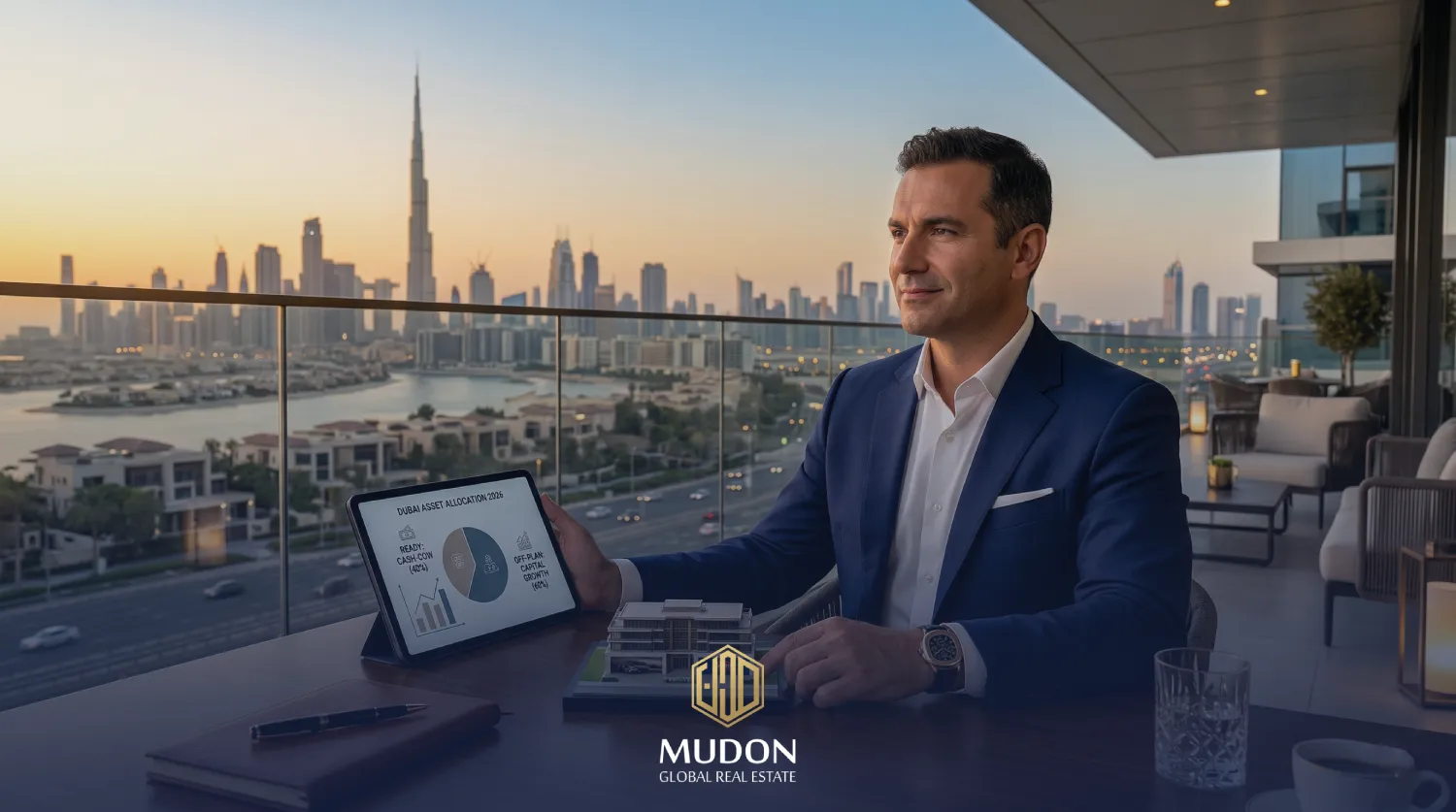
To achieve the optimal balance in your real estate portfolio, we recommend applying the (60/40) allocation strategy tailored to the dynamics of the UAE market, which ensures both liquidity and capital preservation simultaneously:
1. Allocate 40% to Income-Generating Assets (Cash-Cow Assets)
This portion of the portfolio is designated for acquiring ready properties in areas with robust rental demand, with the objective of generating immediate cash flows that cover financial obligations or installments.
- Where to invest? Direct this allocation toward luxury apartments (one- or two-bedroom) in areas such as Business Bay and Dubai Marina.
- Financial objective: Achieve gross rental yields ranging between 6.5% and 7.5% annually, particularly when properties are operated as short-term rentals (Holiday Homes).
2. Allocate 60% to Capital Growth Assets (Capital Growth Assets)
This is the true wealth-multiplying engine. Allocate this portion to purchasing off-plan properties (Off-Plan) of ultra-luxury specification or rare assets in exclusive locations.
- Where to invest? Direct liquidity toward branded residences such as Bugatti and Mercedes Residences or exclusive villas on Palm Jumeirah and Dubai Hills.
- Financial objective: Utilize flexible payment plans (Leverage) and capture a price premium exceeding 40% upon completion, achieving historical capital appreciation that preserves wealth for future generations.
Geographic Diversification: Do not place your wealth in a single neighborhood
A classic mistake some foreign investors make is purchasing multiple units within the same building or development. Geographic diversification within Dubai is essential to protect the portfolio from localized volatility:
- Stability area (wealth preservation): Acquiring a property on Palm Jumeirah as a “trophy asset.” Rental yield here may be more subdued (5.6%), but capital value grows steadily and demonstrates strong resistance to economic contraction.
- Liquidity area (capital rotation): Owning units in Downtown Dubai provides “high liquidity”; you can monetize the asset (sell) at any time thanks to the permanent global demand surrounding the Burj Khalifa.
Risk Management and Leverage (Leverage) in 2026
The intelligent investor does not immobilize all cash reserves. Dubai now offers financial instruments that allow you to scale your portfolio prudently:
Utilizing Escrow Accounts (Escrow)
Thanks to strict government escrow account regulations, purchasing three off-plan properties with an initial down payment (20% each) has become more viable and secure than paying the full amount in cash for a single ready property, thereby increasing your opportunity to realize capital gains from three distinct assets simultaneously.
Portfolio linkage to the Golden Residency
Instead of concentrating on buying a single AED 2 million property to obtain the visa, you can now assemble a portfolio comprising two properties (one ready + one off-plan) with a total value up to AED 2 million.
This tactic provides geographic diversification, cash yield, and Golden Residency for your extended family in a single strategy.
Ownership Structuring and Estate Protection: Do Not Buy in Your Personal Name!
Sophisticated investors understand that acquiring a large property portfolio in individual names can expose it to legal complexities or inheritance taxes in their home jurisdictions. The prevailing strategy for 2026 in Dubai is to establish a Special Purpose Vehicle (SPV) or a Family Foundation in financial centers such as the Dubai International Financial Centre (DIFC).
Purchasing properties and registering them under this holding company delivers three core advantages:
- Complete confidentiality: Protecting the identity of the beneficial owner of the assets.
- Tax efficiency: Isolating your Dubai assets from stringent tax regimes in your country of residence.
- Smooth wealth transfer: Ensuring seamless transfer of the real estate portfolio to future generations or heirs without the complexities of probate, preserving the continuity of your real estate holdings.
Periodic Portfolio Review (Portfolio Rebalancing)
Dubai’s real estate market is dynamic and fast-evolving. To preserve portfolio performance, we recommend conducting a semi-annual financial review:
- Flipping strategy: Sell an off-plan asset prior to handover if it achieves a material price jump in the secondary market, and redeploy the proceeds into a new emerging area.
- Rental pivot: Monitor the performance of ready properties; if annual yield declines, immediately convert the asset to a short-term rental model to capture peak tourist seasons and increase revenues.
Exclusive access: Securing off-market deals (Off-Market)
Real wealth is not built from public listings. A substantial portion of elite portfolios consists of off-market transactions; these are ultra-luxury properties or mansions sold discreetly between elite brokers without public listing to preserve the seller’s privacy.
Building a resilient portfolio requires membership in this closed circle. This is where your financial and real estate advisor provides “early access” to projects not yet offered to the public, enabling you to secure the best units at favorable prices before competition intensifies.
Frequently Asked Questions (FAQ)
What happens to my Dubai property portfolio in the event of death (for non-Muslim foreign investors)? Do local inheritance laws apply?
Thanks to Federal Decree-Law No. (41) of 2022 (Civil Personal Status Law for non-Muslims), Sharia inheritance rules no longer apply to non-Muslim foreign nationals. The new law stipulates that in the absence of a will, the estate is automatically divided 50% to the spouse and 50% distributed equally among the children.
However, for significant investors, this mandatory distribution may not align with their succession plans. Therefore, the most definitive and secure solution to protect an estate is registering the portfolio through the “DIFC Wills Register”.
This measure prevents prolonged freezing of real estate assets in the courts and grants you absolute legal authority (100%) to distribute your wealth to whomever you choose (individuals or institutions) in accordance with your home country’s laws or your written personal wishes.
How does portfolio diversification in Dubai protect my wealth from global currency volatility? (Currency Hedge)
The UAE dirham (AED) has been closely pegged to the US dollar (USD) at a fixed exchange rate (3.6725) since 1997. For European, British, or Asian investors, holding a property portfolio in Dubai effectively equates to holding “dollar-backed assets.”
This functions as a powerful financial hedge that protects your wealth from depreciation of your local currency and ensures stable, globally transferable rental returns without exchange-rate volatility risk.
Can I use bank financing (mortgage) to build my portfolio in Dubai as a non-resident?
Certainly. Banks in the UAE allow foreign (non-resident) investors to obtain mortgage financing up to 60% of the property’s value (LTV). Sophisticated investors use this “leverage” to avoid immobilizing all liquidity; they pay only 40% in cash and rely on Dubai’s elevated rental yields (typically between 6% and 8%) to comfortably service bank repayments.
This means the property’s income services the loan over time, while the investor retains the full capital appreciation.
With the recent implementation of corporate tax in the UAE, will taxes be applied to returns from my property portfolio?
According to Federal Decree-Law No. (47) of 2022 on Corporate Tax, rental income and capital gains (on sale) resulting from personal real estate investment are fully exempt from tax (100%) for individuals.
For investors who prefer privacy and establish “Family Foundations” in the DIFC to manage their portfolios, the law allows such foundations to apply for “tax transparency”; under this regime, the family foundation is treated for tax purposes as an individual (a natural person), preserving full tax exemption while protecting assets.
Is your real estate portfolio positioned to realize its full potential?
Ultra high-net-worth real estate wealth management does not tolerate randomness; it requires precise guidance supported by live market data. Let our experts at Mudon Global analyze your current portfolio or engineer your future portfolio from the ground up.
Contact us now to book a private, closed advisory session for wealth management in 2026.